

24-Hour Economy is About Productivity, not Round-the-Clock Work – Goosie Tanoh
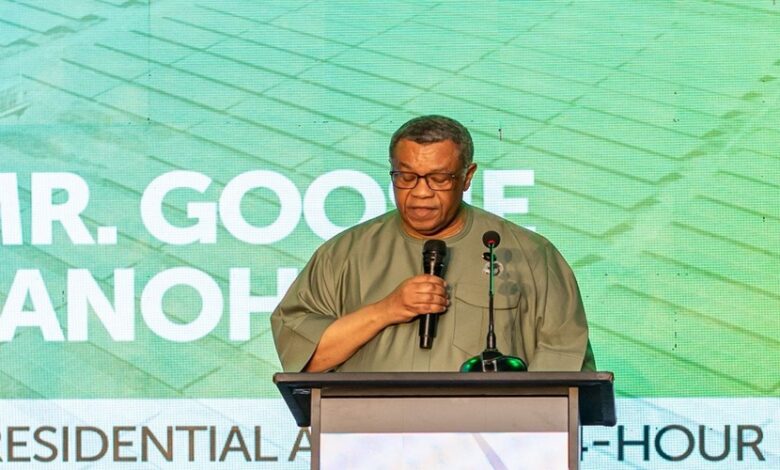
The Presidential Adviser at the 24-Hour Economy Authority, Goosie Tanoh, has clarified that the government’s 24-Hour Economy initiative is not about making Ghanaians work around the clock but about transforming the country into a high-productivity economy driven by industrialisation, innovation and value addition.
In a statement delivered on his behalf by the Director of Partnerships at the 24-Hour Economy Authority, Ishmael Nii Amanor Dodoo, at the Made in Ghana Business Summit 2026 in Accra, Mr Tanoh said the policy is designed to maximise Ghana’s productive capacity by ensuring industries operate more efficiently while creating better-paying jobs and expanding economic opportunities across multiple sectors.
He explained that the initiative seeks to build an economy where businesses operate efficiently, technology enhances productivity and citizens have greater opportunities to contribute to national development. According to him, the focus is on increasing production and competitiveness rather than simply extending business operating hours.
Mr Tanoh stressed that sustainable economic growth would depend on Ghana moving away from exporting raw materials to producing high-value manufactured goods for both local consumption and international markets. He said the country must shift from exporting cocoa, bauxite, timber and raw agricultural produce to manufacturing premium chocolate, aluminium products, quality furniture and processed foods.
He identified industrialisation as the foundation of long-term economic prosperity, noting that it creates value, boosts incomes, encourages innovation and generates quality employment. He therefore called for increased investment in manufacturing, agro-processing, pharmaceuticals, renewable energy, digital technologies, textiles, automotive assembly and mineral beneficiation.
The Presidential Adviser also described youth entrepreneurship as a key pillar of the 24-Hour Economy, pointing out that more than 60 per cent of Ghana’s population is under the age of 35. He said government must empower young entrepreneurs through affordable financing, skills development, incubation centres, improved digital infrastructure, simplified regulations and stronger collaboration between government, academia and industry.
Also speaking at the summit, Technical Advisor to the Commissioner-General of the Ghana Revenue Authority (GRA), Elsie Appau-Klu, announced that the Authority exceeded its June revenue target, collecting GH¢22.71 billion against a target of GH¢22.48 billion. She attributed the performance to strong contributions from both the Domestic Tax Revenue and Customs Divisions, noting that Customs surpassed its monthly target for the first time in several months.
Mrs Appau-Klu described the achievement as a collective effort but stressed that it represents only one step toward meeting the Authority’s annual revenue target. She commended taxpayers and GRA staff for their contribution to the performance.
Meanwhile, Founder and Chairman of the Entrepreneurs Foundation of Ghana, Sam Ato Gaisie, called for greater investment outside Accra to support the objectives of the 24-Hour Economy. He said excessive concentration of economic activity in the capital has contributed to congestion, housing shortages and recurring flooding, while many regions remain underdeveloped despite their abundant agricultural, mineral and tourism resources.
Mr Gaisie urged government and the private sector to establish factories, processing plants, logistics hubs, technology centres and service industries across the regions, arguing that balanced regional development would create jobs closer to where people live and unlock the country’s full economic potential.



