Ghana’s Reset Agenda Anchored on Financial Health
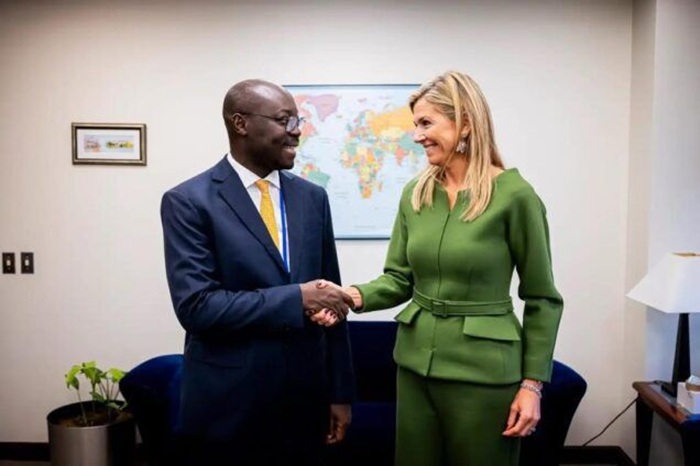
Ghana’s economic transformation agenda is increasingly being shaped by a renewed focus on “financial health,” with Finance Minister Cassiel Ato Forson positioning it as a central pillar of the country’s reset strategy.
Speaking after a high-level engagement with Queen Máxima, who also serves as the United Nations Secretary-General’s Special Advocate for Financial Health, Dr. Forson said the discussions marked a shift from conventional financial thinking toward a more people-centred approach to economic policy.
Describing the meeting as a privilege, the Minister noted that the conversation extended beyond traditional financial inclusion metrics to focus on how financial systems can genuinely empower individuals.
“Our conversation went beyond finance in its narrow sense. We spoke about financial inclusion, but more profoundly about financial health, where individuals are not merely connected to the financial system, but are empowered by it,” he stated.
Dr. Forson emphasised that Ghana’s evolving economic philosophy seeks to move beyond macroeconomic indicators and place greater emphasis on the real-life experiences of citizens. According to him, economic performance should ultimately be measured by how well individuals are able to withstand shocks, access opportunities, and plan their futures with confidence.
“At its core, an economy is not a compilation of figures. It is a living expression of human agency,” he said. “It reflects whether people can withstand shocks, pursue opportunity, and plan their futures with confidence.”
He explained that the government’s reset agenda is anchored on ensuring that macroeconomic gains translate into meaningful improvements in household welfare.
“Stability must translate into security for households. Growth must translate into opportunity for individuals. And access must translate into dignity for all,” the Minister stressed.
The Finance Minister further highlighted the need to redesign financial systems to make them more inclusive, accessible, and responsive to the needs of the population. He argued that financial institutions must function as practical tools that support everyday life, rather than distant systems that are difficult for citizens to navigate.
“Financial systems must not exist as distant structures that people navigate with difficulty. They must function as instruments that enable life to be lived with certainty, purpose, and hope,” he added.
Dr. Forson reiterated that Ghana’s long-term goal is to build an economy defined by broad-based inclusion, where participation is universal and opportunities are accessible to all segments of society.
“The true test of our progress is not the strength of our aggregates, but the strength of our people,” he concluded.
The engagement forms part of ongoing government efforts to deepen financial inclusion, strengthen resilience, and promote equitable growth, as Ghana continues to align its economic policies with a more human-centred development framework.