University dons commend China’s Green House Int’l Group
By Isaac AIDOO, Afienya
Authorities at the University of Ghana, Legon have described as transformational the operations of Bright International Free Zones owned by China’s Green House International Development Group in the Afienya free zones enclave in the Greater Accra region.
According to them, the myriad of specialties and modes of skill sets of Ghanaian youth on display remained pivotal to Ghana’s quest to industrialise its economy.
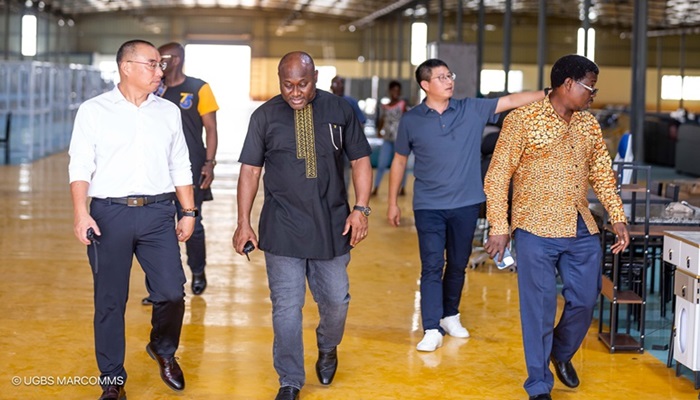
These positive remarks were made after a tour of the industrial zone by the Director of the Confucius Institute, the Pro- Vice Chancellor of the University of Ghana, the Dean of the University of Ghana Business School and the Coordinator of the Business School’s Incubation and Innovation Hub.
The visit formed part of efforts to explore internship opportunities for students of the University, under its Student internship policy launched in 2023.
The industrial park which sits on over 1,200 acres of land is set to integrate companies, large-scale, wholesale markets, warehousing and logistics, manufacturing, factories, housing, finance, entertainment, education and property.
It provides one-stop service for enterprises to settle in. The Free Zone upon completion is set to become the landmark and model for the future development of the Belt and Road initiative in Africa.
The Dean of the Business School, Prof Justice Bawole told The New Finder that he was impressed with the training of young talents at the truck assembling plant where 99 per cent of the workers there were Ghanaian young people. The development, he maintained had great implications for skills upgrade and technology transfer.
“As a Business School , we are struggling to get places that will provide our students with real work-life experiences and perspectives that are international and global so we are going to be working closely with our Confucius Institute and the Green House Group to see how we can get internship placements for our students and to get some of our students employed here after they have completed school,” Prof Bawole stated.
With many students from the Business School’s Innovation and Incubation Hub working on various innovation projects, Prof Bawole was confident that students working on such projects would find ready support from the free zones activity in terms of the technology they would need to complete their projects.
Pro Vice-Chancelor of the University, Prof. Gordon Awandare explained that the University’s students internship policy which was launched last year was meant to formalise practical training and as such a facility such as the Afienya industrial zone “gives enormous opportunity for our students to come and get hands-on experience in working in all the different aspects of industry, from the practical, technical aspects to the business development aspect, management and financial aspects of the entire business cycle.”
Director of Confucius Institute Prof Wang Jimin stressed the Institute’s commitment to strike strategic partnerships with educational institutions in Ghana what will boost the Ghanaian economy through industrialisation.
The partnership between the University and the Confucius Institute is meant to give real meaning to the linkage between industry and the academia.