

$150m projects take off
-To deliver 582 projects in northern and Oti regions
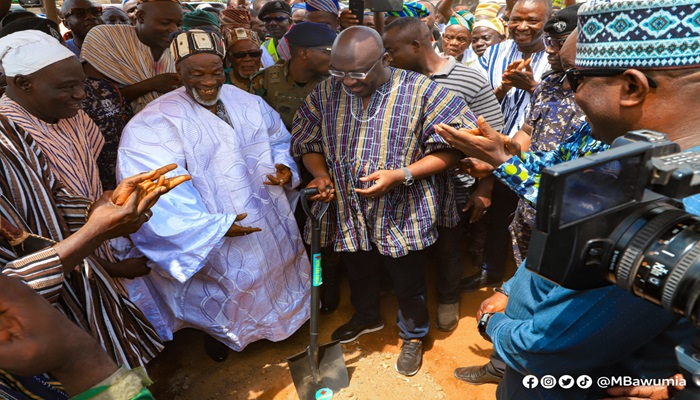
Vice-President Dr. Mahamudu Bawumia signaled the beginning of construction work on all 582 projects under the Gulf of Guinea Northern Regions Social Cohesion (SOCO) initiative with a symbolic groundbreaking ceremony at the palace of the Overlord of Dagbon, His Majesty Yaa Naa Abukari Mahama II.
The SOCO Projects, planned for execution in 48 beneficiary Metropolitan, Municipal, and District Assemblies (MMDAs) across six regions, primarily in the northern part of Ghana, have been considered a significant and timely intervention to address key emerging and recurring challenges in the region.
The beneficiary districts, under a $150 million Credit Facility Project secured by the Government of Ghana from the World Bank, include Northern (8 District Assemblies), North East (6 District Assemblies), Upper East (15 District Assemblies), Upper West (11 District Assemblies), Savannah (4 District Assemblies), and Oti (4 District Assemblies).
The SOCO Project, as described by officials from the Ministry of Local Government, Decentralization, and Rural Development, aims to mitigate the effects of conflict and extremism spilling over from the Sahel Region, reduce vulnerability due to climate change impacts, strengthen local institutions, enhance economic opportunities, and build public trust.
Speaking at the sod-cutting ceremony Vice-President Dr Bawumia emphasized that the Ghanaian government is fully aware of the growing human and security threats in the Sahel Region arising from climate change and conflicts.
He underscored that the government is taking appropriate measures to prevent these threats from spreading into Ghana. This includes creating meaningful jobs and providing opportunities for economic, social, and other means to improve lives.
“In this regard, the SOCO Project focuses mainly on border communities in these regions where citizens, especially women and youth, are exposed to the threats of terrorism from the Sahel Region. Thus, the project focuses on addressing issues related to Fragility, Conflicts, and Violence (FCV),” he added.
Another critical concern is the impact of climate change. Climate change poses a multiplicative threat and exacerbates fragility and conflict dynamics, particularly related to access to natural resources.
Given that a significant portion of the northern population relies on rain-fed agriculture, adapting and building resilience to changing climatic conditions becomes a challenge. Hence, the necessity for the SOCO projects.
Phase I
In Phase I of 2023, the project is set to deliver socio-economic community-level climate-resilient infrastructure, skills development, and training for youth and women, particularly those considered vulnerable. These projects include providing water, constructing school buildings, health facilities, markets, earth dams, and other critical physical infrastructure.
The project has already generated employment for 434 Community Facilitators (CFs) and other specialists.
It is expected to enhance access to basic social and economic services, promote local economic development, gender equality, and improve environmental management when executed efficiently.
The beneficiary regions and districts were meticulously selected based on Vulnerability Index Criteria, which considered exposure to security risk, climate vulnerability, poverty incidence, and unemployment rates.
Vice President Bawumia stressed the importance of adhering to the project’s timeline and cautioned against implementation delays.
He emphasized the need for the delivery of the project through decentralized structures to result in outcomes and impacts as outlined in the Project Appraisal Document (PAD) and Project Implementation Manual (PIM).
The Minister for Local Government, Decentralization, and Rural Development, Daniel K Botwe, assured traditional leaders and residents of the communities of the Ministry’s commitment to collaborating closely with them to ensure smooth project implementation. Contractors and agencies were instructed to provide regular updates on progress to stakeholders.
The Member of Parliament for Yendi, Farouk Aliu Mahama, expressed his gratitude for the SOCO project, highlighting its potential to bring tangible development to the local communities, a departure from previous instances where development was promised but not delivered.



