India trains 4,000 Ghanaians through ITEC programme
By Isaac AIDOO, Accra
About 4000 Ghanaian nationals have benefited from the Indian Technical and Economic Cooperation (ITEC) programme since its inception, building their capacities in various fields, High Commissioner of India to Ghana, Mr Manish Gupta, has revealed.
Government officials, parliamentarians, civil servants, journalists, professionals and executives in the private sector and in the security services have had the opportunity of training in India.
ITEC is about cooperation and partnership for mutual benefit. It is response oriented and it addresses the needs of developing countries.
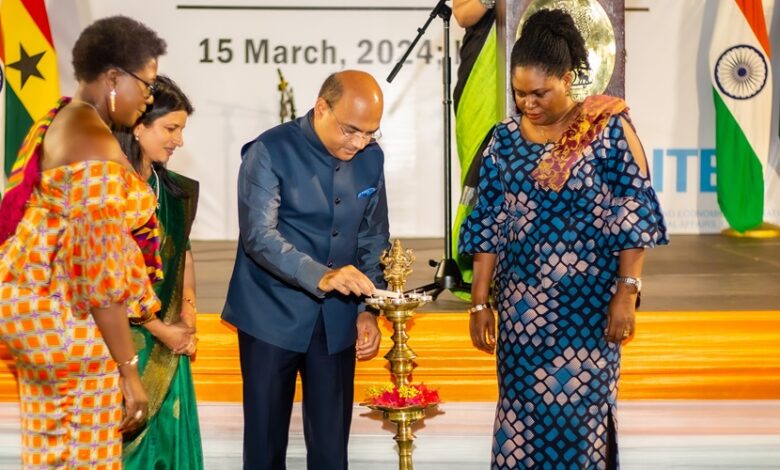
Addressing alumni of the ITEC programme at an evening session dubbed ‘India-Ghana Partnership Day,’ Mr Gupta was delighted with the positive feedback received from beneficiaries of the programme.
Held at the residence of the Indian Envoy to Ghana, the occasion offered an opportunity to the alumni of various Indian Institutes to renew their association with India.
The High Commission had earlier indicated that it attached great importance to “this event since it gives us also a chance to meet
our ITEC/IAFS/ICCR beneficiaries personally who have been to India and to know about their experiences and feedback.”
Mr Gupta further revealed that “since its inception, the cumulative contribution of the Government of India to the ITEC programme is about $3billion.”
According to him, on a normal basis, the programme offers 10,000 fully funded slots, training opportunities on annual basis.
With a large part of ITEC assistance dedicated to Africa, India has on an annual basis provided 250 fully-funded slots towards the higher education sector for graduates, postgraduates and doctorate programmes , technical and economic cooperation programmes in various disciplines and with different durations, defence training as well as ICT digital technologies, health and governance.
Since its inception, training of thousands of nominees of ITEC partner countries have been the most successful cooperation programme and is highly appreciated by the recipient countries.
The training sessions, for both civilian and defence personnel, have constituted about 40 percent of annual ITEC programme budget.
Mr Gupta was impressed with the long-standing cooperation between the two countries, as he recalled some of the major investments India had undertaken in Ghana over the years.
The interaction was attended by government officials, members of the diplomatic community in Ghana, heads of public and private institutions and traditional leaders.
The High Commissioner noted that India’s digital prowess and youth demographics had heralded a new transformation in the country while its industry was at the forefront of innovation and was churning state-of the art technologies at very competitive prices.
He noted that “it is heartening to see the partnership with Ghana is going to the next level where the government to government ties are ably supported by people to people ties,”
Ghana’s Chief Director at the Ministry of National Security, Ambassador . Sena Siaw Boateng noted that the existing healthy relationship between India and Ghana had been attained as a result of the shared values, culture and pursuit to work together towards addressing the common challenges of the two countries.
The Chief Director noted that the increase in the number of slots for Ghanaians to train in India was positive and showed the effort India was making to build the capacity of the Ghanaian trainees, aimed to boost the Ghanaian economy.