

Migration Research Vital for Africa’s Growth – UG Vice Chancellor
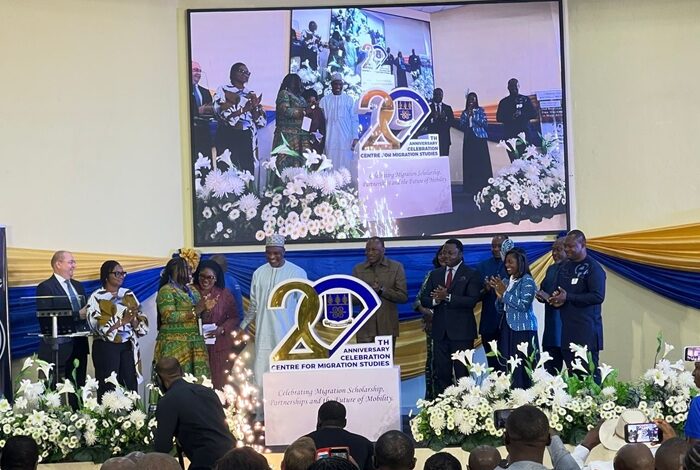
Professor Nana Aba Appiah Amfo, Vice Chancellor of the University of Ghana (UG), has emphasized the critical role of migration research in promoting Africa’s development.
Speaking during the launch of the 20th anniversary of the Centre for Migration Studies (CMS) and the opening of a three-day International Conference on Movement in Africa, held in Accra to mark the milestone, Prof. Amfo described migration as essential for economic resilience, human security, skills development and regional integration.
The CMS anniversary celebration carried the theme, “Celebrating Migration Scholarship, Partnership and the Future of Mobility,” while the conference focused on “The Realities of Free Movement in West Africa: Governance, Norms and Social Transformation.”
According to Prof. Amfo, the work and achievements of CMS over the past two decades align closely with UG’s strategic priorities, particularly in impactful research, transformative student experience, and meaningful partnerships.
She noted that migration is one of the oldest forms of human activity, historically shaping civilizations, driving innovation, fostering cultural exchange, and contributing significantly to economic and social development.
“Contemporary migration research is even more critical, given the growing links between mobility, labour markets, regional integration, and sustainable development,” she said.
Prof. Amfo highlighted labour mobility as a vital tool for addressing unemployment, skills mismatches, and livelihood challenges across West Africa. She added that governments, institutions, and regional bodies share responsibility in this regard.
She also noted that CMS has enhanced student learning through specialized programmes, training, and capacity-building initiatives, producing graduates who are globally competitive and contribute meaningfully across diverse professional fields.
Welcoming the International Conference on Movement in Africa, organised in collaboration with the Danish National Research Foundation Centre of Excellence for Global Mobility Law at the University of Copenhagen and the IDRC Research Chair, West Africa, Prof. Amfo said the event offers a platform to examine the governance of movement, safeguard rights and dignity, and explore how societies can maximize the benefits of human mobility while managing its challenges.
She commended CMS for two decades of impactful scholarship and expressed confidence that the Centre would continue to shape migration policy, academic discourse, and public understanding in Africa and beyond.
On his part, Minister for the Interior Mohammed Muntaka Mubarak described CMS as a leading institution in migration research, capacity building and policy engagement.
He said CMS has helped elevate migration from a peripheral concern to a key development priority within national and regional policy frameworks.
The Minister highlighted the Centre’s technical support in developing major national frameworks, including the National Migration Policy, the National Labour Migration Policy, and the Diaspora Engagement Policy.
“These interventions have positioned Ghana to manage migration in a more strategic, compassionate, and development-oriented manner,” he stated.
Mr. Mubarak acknowledged that while migration management often prioritizes security, there is a growing need to balance enforcement with humanity. He expressed confidence that CMS would continue supporting the Ministry and other stakeholders through innovation, strengthened partnerships, and evidence-based approaches to migration governance that deliver tangible development outcomes.
Prof. Mary Boatemaa Setrana, Director of CMS, said the Centre is actively positioning its programmes, research, and training initiatives to expand postgraduate enrollment, advance impactful research, deepen policy engagement, and strengthen regional and international partnerships.
She appealed to the government and UG management to support CMS in recruiting three to five additional permanent faculty members to address current inadequacies.



