

Ghana Takes Lead in West Africa’s Green Building Market
By Praisebell Rosemond Larbi
Ghana has consolidated its position as West Africa’s leading green construction market following the successful close-out of a three-year capacity-building program led by the International Finance Corporation (IFC), signalling growing commercial and investment opportunities in sustainable building across the country.
The IFC’s Designing for Greater Efficiency (DfGE) program, implemented with funding from the Swiss State Secretariat for Economic Affairs (SECO), has played a pivotal role in strengthening local skills, modernising academic curricula and accelerating private-sector adoption of internationally recognised green building standards.
Launched in 2022, the program embedded green building design into the teaching frameworks of five universities, a professional association and a technical institute. In total, 254 students and industry professionals received direct training, while 30 certified trainers were prepared to deliver the curriculum sustainably beyond the program’s lifespan. More than 870 additional participants were reached through workshops, awareness sessions and national design competitions.
IFC officials say these outcomes position Ghana among the strongest performers globally within the DfGE initiative, alongside countries such as Colombia, Peru, Indonesia and South Africa, and reflect a construction market that is increasingly ready to scale low-carbon and climate-resilient building solutions.
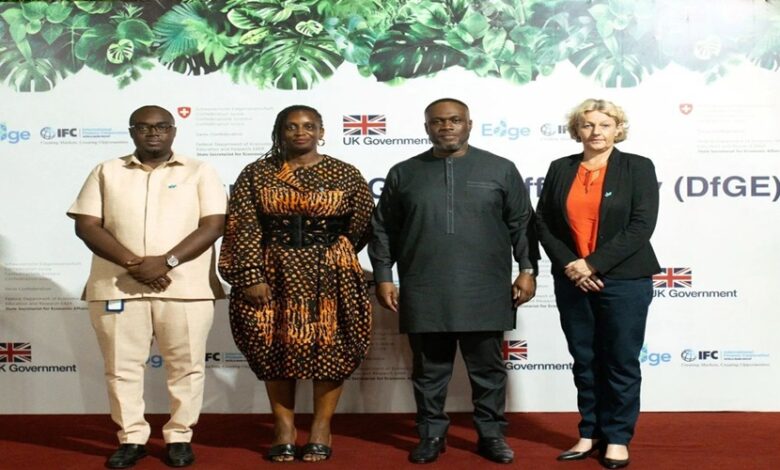
Speaking at the program’s close-out event in Accra, IFC Senior Country Officer Yewande Giwa said Ghana’s progress demonstrates that green construction is no longer just an environmental aspiration, but a commercially viable and investable sector.
“The skills developed through this program are critical for innovation, job creation and long-term growth. As demand for energy-efficient and climate-resilient buildings increases, Ghana is well positioned to meet that demand,” she said.
The impact is already evident in market uptake. The IFC announced that Ghana has surpassed one million square metres of EDGE-certified green building space, the highest in West Africa, with more than 81 certified residential, commercial and public-sector projects nationwide.
According to IFC Green Building Lead for Ghana, Paul Ocran, the milestone signals a shift from policy ambition to market reality. He noted that EDGE certification has helped developers demonstrate that green buildings lower operating costs while remaining financially attractive.
“Sustainability is increasingly being seen as good business. EDGE gives developers and investors confidence that efficiency gains can be achieved without sacrificing profitability,” Mr. Ocran said.
The DfGE program also placed strong emphasis on inclusion, with women accounting for more than a quarter of participants. This, IFC officials say, reflects gradual but important progress in diversifying a construction industry traditionally dominated by men.
Representing SECO, Magdalena Wüst said Switzerland’s support was aimed at equipping Ghana’s workforce with practical, market-relevant skills needed to deliver low-carbon buildings at scale. She added that the benefits of the program would continue well beyond its formal close-out.
Government officials have welcomed the initiative as aligned with Ghana’s broader development and climate objectives. Minister for Works, Housing and Water Resources, Kenneth Gilbert Adjei, noted that buildings account for a significant share of national energy consumption and emissions, warning that rapid urbanisation makes sustainable construction both a business necessity and a policy priority.
He said the government will continue working closely with development partners, academia and the private sector to expand climate-resilient housing and infrastructure, describing the DfGE program as a strong foundation for transforming Ghana’s built environment.
With the DfGE online course remaining accessible and EDGE certification gaining momentum among developers, the IFC believes Ghana now has a robust ecosystem to attract climate-smart investment and support the growth of a competitive, low-carbon construction industry, reinforcing its leadership role in West Africa’s green building market.



