

Ghana, Netherlands Deepen Cooperation to Tackle Illicit Finance
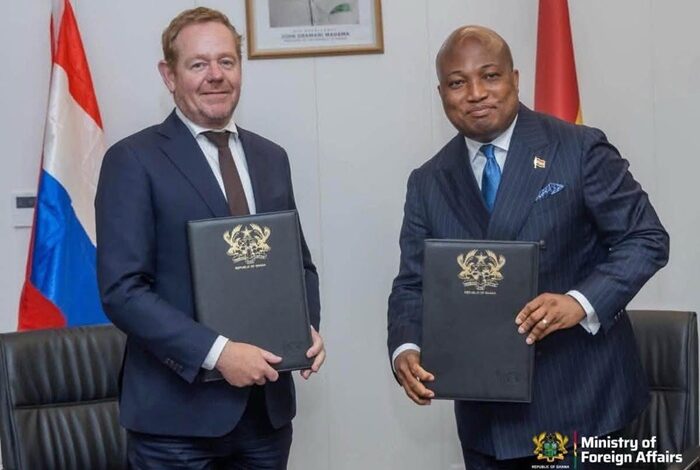
Ghana and the Netherlands are strengthening cooperation to combat drug trafficking, organised crime and illicit financial flows under a new Letter of Intent aimed at disrupting criminal networks operating between West Africa and Europe.
The agreement was signed by Foreign Affairs Minister Samuel Okudzeto Ablakwa and Dutch Minister for Justice and Security David Van Weel during the Dutch minister’s official visit to Ghana. It builds on the Accra Call to Action adopted by Ghana, the Netherlands and other stakeholders in November 2025.
The partnership will focus on intelligence sharing, border surveillance, joint investigations and efforts to trace and disrupt criminal proceeds linked to drug trafficking.
The agreement comes as Ghana intensifies efforts to strengthen intelligence-led monitoring of its borders and ports. Interior Minister Muntaka Mubarak said in July that the government was moving towards intelligence-led border surveillance, with support from the Netherlands to acquire high-resolution scanners capable of detecting narcotics and ammunition.
Ghana’s drug enforcement agencies have recorded significant seizures in recent years. More than 16.8 tonnes of narcotic substances, including cocaine, heroin, cannabis and synthetic drugs, were destroyed in June 2025. The Narcotics Control Commission (NACOC) also reported in April 2026 that drug-related arrests increased by 197 per cent in 2025, with nearly 1,500 kilograms of narcotic substances seized.
The Netherlands also faces significant pressure because of its role as a major European logistics hub. Dutch customs intercepted 24,500 kilograms of cocaine in 2025, compared with 38,000 kilograms in 2024. The port of Rotterdam alone accounted for about 11,500 kilograms.
Beyond the seizure of drugs, the two countries are placing greater emphasis on following the money behind trafficking operations. The Accra Call to Action calls for stronger asset tracing, freezing and recovery mechanisms, as well as improved information sharing among countries.
The financial dimension is particularly important for Ghana, where illicit proceeds can move through legitimate businesses and cross-border transactions. Banks, logistics operators, importers, exporters and other businesses involved in international trade may consequently face increased compliance and reputational risks.
Ghana’s Foreign Affairs Ministry said the two countries share concerns over organised crime, drug trafficking, money laundering and illicit financial flows and are considering a more permanent framework for bilateral cooperation.
Ablakwa said the partnership was necessary to confront drug markets that are damaging public health, undermining the rule of law and affecting young people.
The new agreement signals a shift towards more coordinated action against the networks behind the illicit trade. For Ghana and the Netherlands, its success will depend on turning intelligence sharing and diplomatic cooperation into joint investigations, stronger border controls and effective measures to trace and dismantle the financial structures supporting drug trafficking.



