

Ghana Calls for Overhaul of Global Ocean Governance
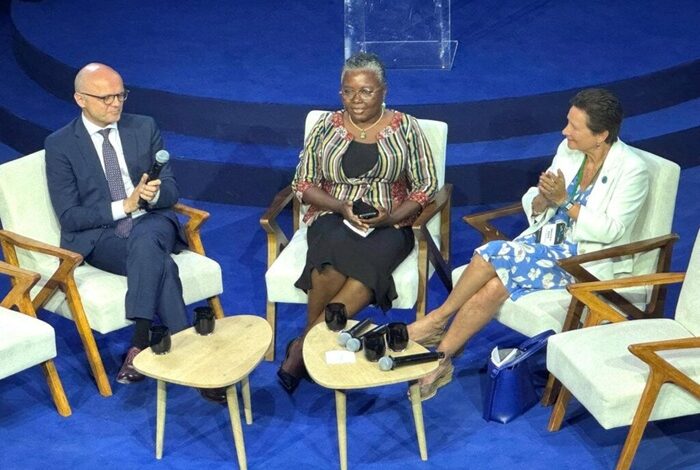
The Minister for Fisheries and Aquaculture Development, Emelia Arthur, has called for a comprehensive overhaul of global ocean governance.
According to her existing international maritime systems are outdated and structurally unfair to developing coastal states.
Speaking at the high-level Neptune Forum in Paris, convened by Mission Neptune to mark World Oceans Day, she said current global frameworks are overly extraction-focused and fail to ensure equity, sustainability and shared responsibility in ocean management.
She warned that declining fish stocks, threats to marine biodiversity, increasing coastal vulnerability, and persistent maritime insecurity continue to undermine the economic and social stability of ocean-dependent nations, particularly in Africa.
The Minister stressed that ocean governance must shift from resource exploitation to a more inclusive, science-driven, and legally equitable system that prioritizes both environmental protection and the livelihoods of coastal communities.
She argued that advances in technology, including real-time vessel monitoring, artificial intelligence, marine data collection, and seabed mapping, are not being matched by fair regulatory systems, allowing advanced economies to dominate ocean data while vulnerable states bear the environmental costs.
Madam Arthur further noted that Illegal, Unreported and Unregulated (IUU) fishing remains a major threat to food security, national sovereignty and the survival of artisanal fishing communities across the Gulf of Guinea and other African coastal areas.
She said foreign industrial fleets continue to exploit weak enforcement systems, depleting marine resources and undermining the livelihoods of millions of fishers, and called for stronger global compliance and enforcement mechanisms.
The Minister outlined Ghana’s Blue Economy agenda, which integrates sustainable fisheries management, modern aquaculture development, marine spatial planning, and strengthened enforcement systems, alongside community participation in resource protection.
She said the Ministry for Fisheries and Aquaculture Development is building localized systems to safeguard maritime resources from external exploitation while supporting coastal livelihoods.
Madam Arthur also highlighted five key principles Ghana is advancing for future global ocean governance, including equity in maritime resource distribution, environmental stewardship, scientific sovereignty, recognition of indigenous knowledge, and collective security.
She emphasized that African states must not remain mere consumers of foreign ocean data but should be supported with technology transfer and digital infrastructure to strengthen local marine research and decision-making.
According to her, indigenous coastal communities must also be formally integrated into modern ocean governance systems due to their long-standing knowledge of sustainable marine practices.
She stressed that true ocean conservation can only be achieved through a fair and inclusive international system that balances ecological protection with economic justice and the sovereignty of coastal nations.



