Maritime Investment Critical to Africa’s Trade Competitiveness – GEXIM
Africa’s economic transformation and trade ambitions will depend heavily on sustained investment in maritime infrastructure, technology, logistics and financing, the Ghana Export-Import Bank (GEXIM) has stated.
The bank says the maritime sector remains central to industrialisation, export expansion, investment attraction and employment creation, making it a strategic pillar for both national and continental development.
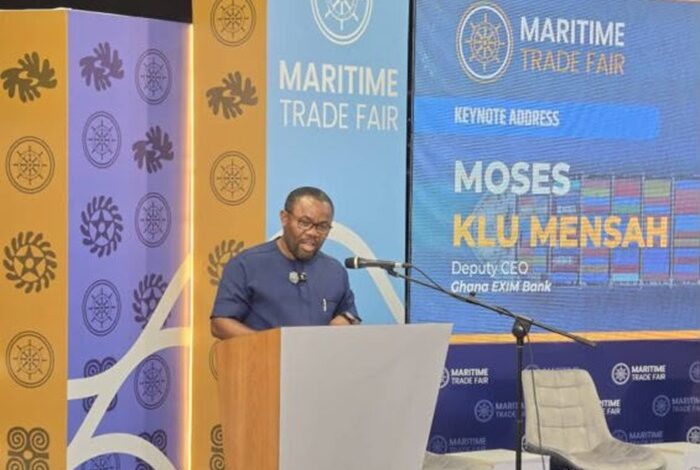
Speaking at the opening of the Maritime Trade Fair in Accra, the Deputy Chief Executive Officer in charge of Banking at GEXIM, Moses Klu Mensah, emphasised the importance of positioning the maritime industry at the heart of Africa’s competitiveness agenda.
The event, organised under the theme “Shaping Africa’s Maritime Future: Maritime, Technology and Finance”, brought together regulators, financiers, insurers, logistics providers, technology firms, industry players and emerging start-ups to explore opportunities and challenges within the sector.
Delivering remarks on behalf of GEXIM Chief Executive Officer, Sylvester Adinam Mensah, Mr Mensah said the maritime economy should be viewed as a strategic enabler of trade and industrial growth.
He explained that maritime activities directly influence the movement of goods, production efficiency and the overall cost of doing business, while providing critical links between producers and international markets.
According to him, Africa’s ability to maximise opportunities under the African Continental Free Trade Area (AfCFTA) will depend largely on the strength of its ports, logistics systems, financing structures and regulatory environment.
Mr Mensah noted that efficient ports, reliable logistics networks, affordable financing, responsive regulation and modern technological systems are indispensable for building a competitive export-led economy.
He identified access to finance as a major requirement for businesses operating across the maritime value chain, including exporters, freight forwarders, logistics companies, warehousing firms, insurers and technology providers.
He said institutions such as GEXIM play an important role not only by providing finance but also by supporting businesses to become export-ready and competitive in global markets.
The Deputy CEO further stressed the need for policymakers and industry stakeholders to align infrastructure development, regulation and investment priorities to address operational bottlenecks, reduce transaction costs and improve the movement of goods across ports and borders.
He also highlighted the growing role of technology in modern maritime operations, arguing that digital innovation has become essential for improving efficiency, transparency and risk management.
Digital solutions, he said, can enhance cargo tracking, customs administration, payment systems, insurance verification and access to trade-related information.
“The future of maritime trade will belong to countries that combine physical infrastructure with digital capability,” he stated.
Mr Mensah further called for sustained investment in maritime infrastructure, logistics networks and industrial value chains, noting that Ghana possesses significant advantages, including its strategic geographical location, political stability and ongoing improvements in port infrastructure.
He said these strengths position the country to assume a more influential role in shaping Africa’s maritime future and supporting regional trade integration.
Meanwhile, Executive Director of Whitestone Shipbrokers, Gertrude Adwoa Ohene-Asienim, observed that the maritime industry is experiencing rapid transformation driven by technological advancement, evolving trade patterns, sustainability demands and growing pressure for supply chain efficiency.
According to her, innovations such as digital platforms, fintech solutions, automation and smart logistics systems are reshaping maritime operations and creating new opportunities for businesses across the continent.
Mrs Ohene-Asienim said the Maritime Trade Fair serves as an important platform for dialogue, collaboration and innovation, enabling stakeholders to identify practical solutions to challenges facing the sector.
She further underscored the importance of human capital development, particularly among women and young professionals, stressing that the future of Africa’s maritime industry will be determined not only by infrastructure and technology but also by the quality of leadership and expertise available within the sector.
She called for stronger collaboration among government institutions, academia, industry players and the private sector to unlock the full potential of the maritime economy and support sustainable economic growth across Africa.