

Accra Floods and Deaths: A National Failure of Planning, Discipline, and Enforcement
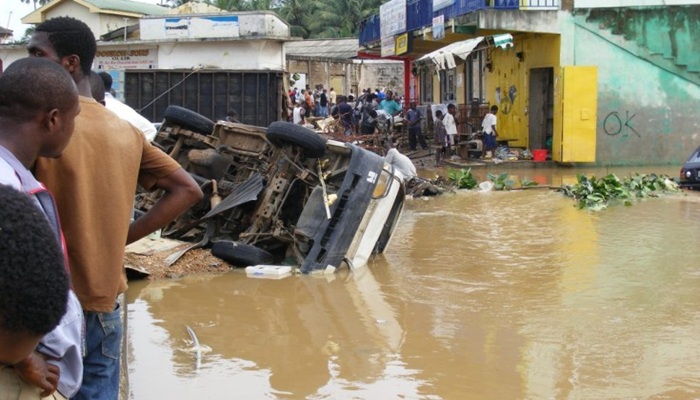
Every major rainfall in Accra now carries an unspoken warning: disruption, destruction, and sometimes death. Floodwaters sweep through homes, roads collapse into streams, vehicles are submerged, and families are left counting losses that are both emotional and economic. Yet after every tragedy, the same question returns, who is to blame for the flooding and loss of lives and property?
The honest answer is uncomfortable: there is no single culprit. Accra’s flooding crisis is the result of shared failures institutional, political, and individual. Nature Is the Trigger, But Not the Cause.
Heavy rainfall is often the immediate cause of flooding, but it is not the root problem. Cities around the world experience far more intense rainfall without the repeated scale of destruction seen in Accra.
The difference lies in preparedness. In Accra, rainfall exposes weak drainage systems, blocked waterways, and uncontrolled urban expansion. In many cases, it is not the rain that causes disaster, it is the inability of the city to manage the rain.
One of the most visible causes of flooding is the rapid and often unregulated expansion of the city. Wetlands and natural waterways that once absorbed excess water have been replaced by residential and commercial developments. In many areas, buildings have been constructed directly on drainage paths, effectively blocking the natural flow of stormwater.
Over time, urban development has outpaced planning enforcement. The result is a city that grows economically but struggles environmentally. Without strong spatial planning and strict zoning enforcement, flooding becomes inevitable.
Even where drainage systems exist, many are outdated, undersized, or poorly maintained. Some were built decades ago for a smaller population and less intense urban activity. Today, these systems are overwhelmed during heavy rains.
In addition, poor maintenance means drains are often clogged with waste, reducing their capacity even further. What should be a functioning drainage network has, in many places, become part of the problem.
Perhaps the most avoidable cause of flooding is indiscriminate waste disposal. Plastic waste, food packaging, and household refuse frequently end up in gutters and drainage channels. When rainfall begins, these blocked systems cannot carry water away, leading to rapid surface flooding.
This is not just a sanitation issue, it is a behavioural and enforcement issue. Without consistent public discipline and enforcement of sanitation laws, even the best infrastructure will fail.
Government agencies and city authorities also carry significant responsibility. While policies and planning frameworks exist, enforcement is often inconsistent. Illegal structures sometimes remain untouched for years until disasters occur. Drainage expansion projects are frequently delayed or underfunded.
In many cases, intervention happens after damage has already been done. A reactive approach to flooding rather than a preventive one, has allowed the problem to persist across successive administrations.
Flooding is often discussed in technical terms, but its human impact is severe. Lives are lost. Families are displaced. Small businesses collapse overnight. School attendance is disrupted. Health risks rise due to contaminated water and stagnant pools.
For many households, a single flood event can erase years of financial progress. The economic cost is equally significant, affecting productivity, transport, and emergency spending.
Climate change is intensifying rainfall patterns and increasing weather unpredictability. This means that cities with weak drainage and poor planning are now more vulnerable than ever. However, climate change is not the root cause, it is a stress test. Moreover, Accra’s urban system is struggling to pass that test.
So, Who Is to Blame? Blame cannot be placed on one group alone, government authorities are responsible for weak enforcement and delayed infrastructure investment, city planners are responsible for allowing uncontrolled urban expansion, citizens contribute through poor waste management and illegal construction and institutions are responsible for maintenance gaps and inadequate drainage systems.
Flooding in Accra is therefore not an accident, it is a consequence of collective neglect over time. The question should no longer be only “who is to blame?” but rather “what must change?”
Accra’s flooding crisis will not be solved by seasonal desilting or emergency responses alone. It requires: strict enforcement of planning laws, continuous drainage maintenance, strong waste management systems, public discipline and environmental awareness and long-term urban redesign.
Until these measures are taken seriously, flooding will remain a recurring tragedy. In addition, each rainy season will continue to expose the same truth: this is not just a natural disaster, it is a human and institutional failure playing out in real time.



