Fidelity Bank Records Strong Growth Across Profitability
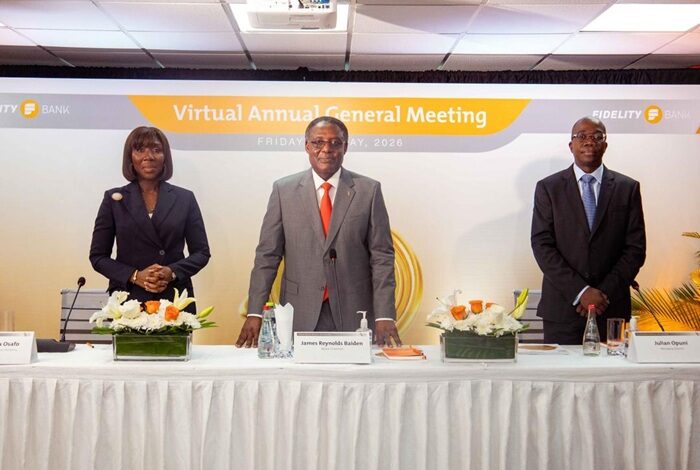
Fidelity Bank Ghana has reported strong financial growth for the 2025 financial year, recording significant gains in profitability, deposits, lending, and digital transformation as it strengthens its position within Ghana’s banking industry.
At the bank’s 2026 Annual General Meeting (AGM), Board Chairman James Reynolds Baiden described the performance as “outstanding,” noting that the bank delivered solid results despite lingering global uncertainties and a gradually improving domestic economy.
According to the bank’s financial results for the year ending December 31, 2025, profit before tax rose by 21 per cent to GH¢1.46 billion, compared to GH¢1.21 billion recorded in 2024.
Operating income also increased by 14 per cent from GH¢2.34 billion to GH¢2.68 billion, supported by growth in both funded and non-funded income streams.
The bank’s balance sheet remained strong during the period, with total assets rising by 17 per cent to GH¢25.98 billion, while wholesale and customer funding liabilities grew by 13 per cent to GH¢21.68 billion.
One of the bank’s strongest performance indicators came from lending activities. Gross loans and advances increased sharply by 51 per cent from GH¢3.14 billion in 2024 to GH¢4.74 billion in 2025, reflecting increased support for corporate clients, small and medium-sized enterprises (SMEs), retail customers, and emerging sectors of the economy.
Managing Director Julian Opuni attributed the bank’s performance to disciplined execution, resilience, and continued investments in innovation and customer-focused banking solutions.
He said Fidelity Bank deepened its digital transformation agenda during the year through investments in automation, analytics, and digital banking platforms aimed at improving customer experience and operational efficiency.
The bank also reported improvements in asset quality, with its non-performing loan (NPL) ratio declining to 7.09 per cent, significantly below the industry average of 18.9 per cent.
According to management, the improvement reflects a proactive risk management strategy and disciplined credit administration.
Following regulatory approval from Bank of Ghana, the board declared a dividend of GH¢11.20 per share.
Beyond its financial performance, Fidelity Bank expanded its sustainability and corporate social responsibility initiatives during the year. The bank disclosed that more than GH¢170 million was directed toward green financing and climate-smart initiatives, while its social intervention programmes impacted over 40,000 people across 10 regions.
The bank also received several local and international awards in 2025, including recognition for SME banking, ESG performance, and private banking services.
Management expressed confidence in the bank’s long-term outlook, stating that Fidelity Bank would continue focusing on innovation, operational efficiency, sustainability, and customer-centred growth to support Ghana’s economic transformation.