

Non-Traditional Exports Surge to $5bn 2025
By Praisebell Rosemond Larbi
Ghana’s non-traditional export (NTE) sector has recorded a historic performance, with total earnings rising sharply by 30.7 per cent to reach $5.006 billion in 2025, marking a significant acceleration from the decade-long average growth rate of 7.53 per cent.
The milestone, captured in the 2025 Non-Traditional Export Statistics Report released in Accra by the Ghana Export Promotion Authority (GEPA), signals a structural shift in Ghana’s export profile toward value-added production and diversification.
According to the report, manufacturing and semi-processed goods continued to dominate the NTE sector, accounting for 83.47 per cent of total export earnings. This underscores the growing importance of industrial processing in enhancing export value and reducing reliance on raw commodity shipments.
Cocoa Derivatives Lead Export Expansion
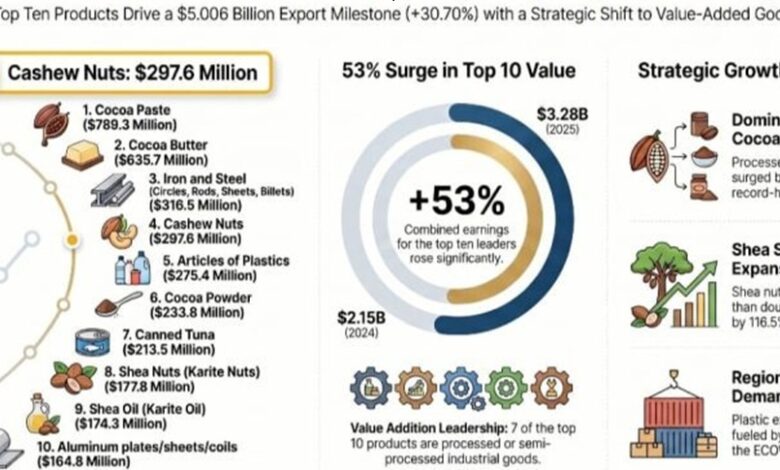
The surge in earnings was largely driven by strong performance in cocoa derivatives, particularly cocoa paste, butter, and powder. Cocoa paste emerged as the single largest contributor, generating $789.3 million, representing a 70.9 per cent increase year-on-year.
Cocoa butter recorded an even more remarkable growth of 120 per cent to $635.7 million, reflecting rising global demand for processed cocoa products and Ghana’s increasing capacity in value addition.
Other key contributors included cashew nuts, which generated $297.6 million, supported by steady international demand. Articles of plastics also recorded robust growth, rising by 37.8 per cent to $275.4 million.
Canned tuna exports increased by 37.3 per cent to $213.5 million, while shea-based products posted strong gains. Shea nuts (karite) grew by 116.5 per cent to $177.8 million, with shea oil following closely at $174.3 million.
Europe and Africa Anchor Export Markets
In terms of destination markets, Europe maintained its position as the leading export region, with the Netherlands serving as the primary hub, importing $831.1 million worth of Ghanaian NTEs. The United Kingdom and France followed, with imports valued at $253.2 million and $231.2 million respectively.
On the African continent, exports reached $1.50 billion, with the ECOWAS sub-region accounting for more than half at $767.8 million. Togo emerged as the leading destination within the bloc, recording $232 million in imports.
The Alliance of Sahel States (AES) also contributed significantly, with total exports of $674.8 million, largely driven by strong trade flows to Burkina Faso, which accounted for $532.2 million.
Challenges Persist in Select Sectors
Despite the overall strong performance, some sub-sectors faced headwinds. The handicrafts sector recorded a decline due to the reclassification of ceramics into the manufacturing category, reflecting changes in statistical reporting.
Similarly, iron and steel exports dipped marginally by 1.59 per cent to $316.5 million, impacted by fluctuating global prices and increased competition on international markets.
Policy Push Toward $10bn Target
Board Chairman of GEPA, Godfred Seidu Jasaw, reaffirmed the Authority’s commitment to scaling up non-traditional exports, expressing confidence that Ghana’s target of achieving $10 billion in NTE earnings by 2030 is attainable.
Chief Executive Officer, Francis Kwarteng Arthur, stressed the need for sustained investment and coordinated interventions to deepen export growth.
Meanwhile, the Minister for Trade, Agribusiness and Industry, Elizabeth Ofosu-Adjare, called for tailored financing solutions, particularly for small and medium-sized enterprises, emphasising the importance of “patient capital” to support long-term expansion.
The latest figures reinforce Ghana’s transition toward a more diversified and value-driven export economy, positioning the NTE sector as a critical pillar of future growth and foreign exchange generation.



