

GNCCI Launches Junior Chamber at UMaT to Tackle Youth Unemployment
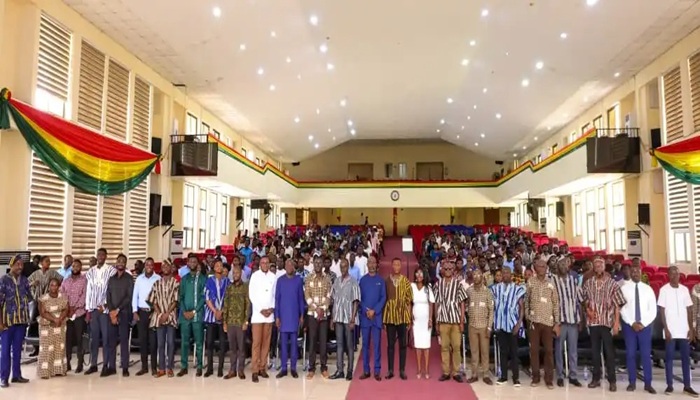
The Ghana National Chamber of Commerce and Industry (GNCCI) has launched a Junior Chamber at the University of Mines and Technology (UMaT) in Tarkwa to equip students in the mining and technology sectors with entrepreneurship training, industry-relevant skills and direct access to the private sector. The initiative is a targeted response to youth unemployment in the country.
The UMaT-GNCCI Junior Chamber, officially launched is the fourth chapter in GNCCI’s rapidly expanding national student entrepreneurship network. It follows earlier launches at Takoradi Technical University (TTU) and the University of Ghana (UG) in 2025, and at the Kwame Nkrumah University of Science and Technology (KNUST) on 12 March 2026.
The inclusion of the University of Mines and Technology is strategically significant. Located in Tarkwa in the Western Region, it remains the country’s only university dedicated to mining and technology education, positioning its graduates at the core of Ghana’s natural resource economy and its technology-driven industrial future.
Bridging the gap between education and employment requires a shift in mindset that prioritises practical training, market-oriented curricula and continuous learning principles that the GNCCI Junior Chamber seeks to promote.
The initiative comes at a time when youth unemployment remains high, particularly among recent graduates, highlighting persistent gaps between tertiary education and industry requirements.
The transition from university to employment continues to pose challenges for many students, especially in sectors such as mining, engineering and technology, where hands-on experience and industry exposure are essential.
The UMaT-GNCCI Junior Chamber will equip students with practical entrepreneurial skills through structured training programmes delivered by GNCCI in collaboration with the business community.
The programme will include industry-led mentorship, business-to-student networking platforms and hands-on exposure to enterprise development. Students will also benefit from training in technology-driven entrepreneurship, as well as targeted access to opportunities under the African Continental Free Trade Area and international markets.
Speaking at the launch, Ebenezer Cobbinah, Municipal Chief Executive of the Tarkwa-Nsuaem Municipal Assembly, described the initiative as timely and relevant to the needs of young people in the municipality. He noted that Ghana’s economy depends on a new generation of entrepreneurs who understand industry, embrace technology and build locally, adding that the GNCCI Junior Chamber provides a structured pathway to achieve this.
Professor Lewis Brew, Dean of Students at UMaT, speaking on behalf of Vice-Chancellor Prof. Richard Kwasi Amankwah, reaffirmed the university’s commitment to the partnership.
He said UMaT aims to produce graduates who not only understand Ghana’s resources but are also capable of building enterprises from them, adding that the Junior Chamber provides the private sector linkages and entrepreneurial foundation required to achieve this goal.
For his part, GNCCI President Stéphane Abass Miezan underscored the deliberate choice of institution.
He explained that the Junior Chamber is not merely symbolic but a national platform that connects the next generation of mining and technology innovators directly to Ghana’s business community, enabling their ideas to evolve into enterprises that create jobs.
He further encouraged students to position themselves not only as job seekers but as job creators.
Other speakers at the event included Georgina Odoom, Chief Executive Officer of Useful Waste Ltd., and John Arthur, Chairman of the GNCCI Tarkwa Branch.
The GNCCI has indicated plans to extend the Junior Chamber model to more tertiary institutions, with the aim of building a national entrepreneurial ecosystem anchored in academia and driven by private sector collaboration.
With four chapters now operational spanning technical, comprehensive, science and technology, and mining-focused institutions the network is steadily expanding its footprint across Ghana’s higher education landscape.



