

Ghana Investment Promotion Center Maps Ashanti Region for Industrial Investment
By Tina Moses Sam
The Ghana Investment Promotion Centre (GIPC) is intensifying its nationwide search for viable industrial assets, signaling a strategic shift toward data-driven capital mobilization in the country’s agricultural heartland.
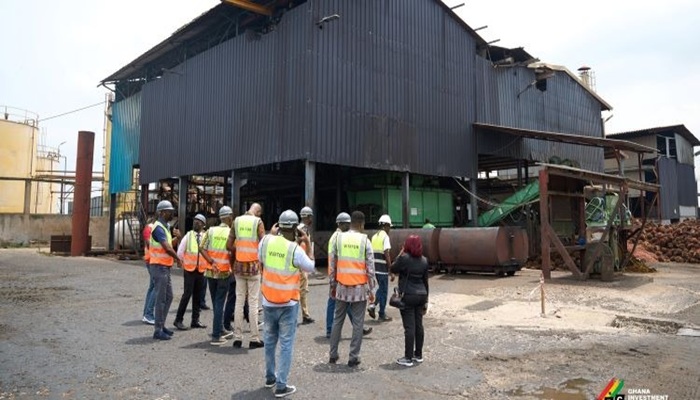
Under its Investment Opportunities Mapping Project (IOMP), a delegation led by Mr. Kwame Kesse-Agyepong, Deputy Director and Head of Investment Promotion and Business Development, recently toured the Ashanti Region to identify high-potential firms.
The mission is part of the Centre’s broader mandate to decentralize economic growth, moving beyond Accra to catalyze local value addition in the palm oil and soybean sub-sectors. The roadshow underscored a commitment to transforming local agribusinesses into investment-ready entities capable of absorbing foreign and domestic capital.
One of the primary stops on the delegation’s tour was Juaben Oil Mills Limited in Kumasi.
Since its inception, the company has grown into a sophisticated operation. During the visit, Managing Director Mr. Alex Owusu emphasized that the company is ready to transition to the next phase of its lifecycle. Their ambition involves a $12.9 million expansion plan that would see the plantation footprint grow to 5,000 hectares and refinery capacity jump to 250 tons per day.
For the GIPC, Juaben Oil Mills represents the exact type of homegrown enterprise that fits the national development model, and by leveraging biomass energy to power its refining operations, the mill is already demonstrating efficiency that can be replicated across the sector.
However, to meet its target of reducing reliance on external raw materials – currently only 10% of their input is sourced from their own plantation – the company requires significant capital injection. The GIPC’s role is to package this requirement and present it to the “global investor community as a scalable, sustainable business model.”
The agency noted that is creating a comprehensive repository of opportunities that align with Ghana’s national Industrialization agenda by visiting legacy producers and emerging processors. This mapping project is not merely an observational tour; it is a tactical effort to de-risk these enterprises for potential investors while providing a clear roadmap for the companies to scale their operations.
In the Bosomtwe District, the GIPC team turned its focus toward the soybean value chain at Vester Oil Mills in Kuntanase-Deduako.
This visit highlighted the need for deeper integration within the domestic market. Unlike palm oil producers who focus on refining and packaging, Vester Oil Mills showcases the complexity of solvent extraction, which is critical for processing northern-grown soybeans into high-value agricultural byproducts.
The firm’s management team, led by Mr. Kwesi Nyamekye, highlighted the potential for substantial growth if they can successfully bridge the gap between regional cultivation and high-end industrial processing.
He revealed that Vester Oil Mills is seeking approximately $5 million to expand its production lines. This investment is not just for raw processing; it includes the launch of dedicated fish and poultry feed production lines, which would allow the company to diversify its revenue streams while providing essential inputs for local livestock farmers.



