

Finance Minister’s Cargo Ban Could Disrupt Transit Trade – GIFF Warns
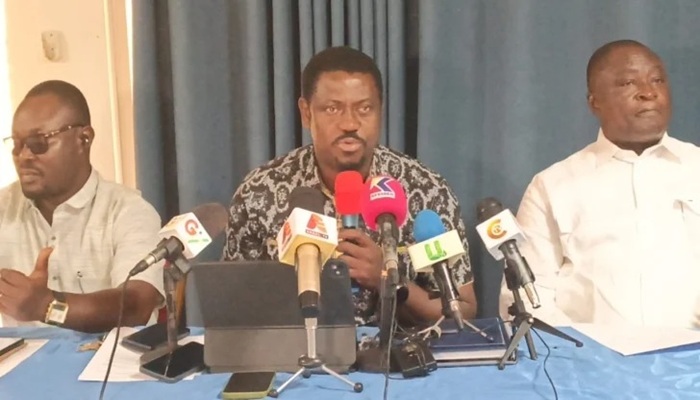
The Ghana Institute of Freight Forwarders (GIFF) has warned that the directive by Dr Cassiel Ato Forson, the Minister of Finance, restricting the transit of commercial quantities of cooking oil through Ghana’s land borders could have consequences for the country’s transit trade.
The directive followed the reported diversion of trucks carrying cooking oil under transit arrangements linked to Bill of Entry (BOE) 80226125039.
Mr Paul K. Mensah, General Secretary of GIFF, speaking to the media in Tema, urged the Minister to conduct an urgent, evidence-based review of the policy actions following the enforcement episode.
He emphasised that the Institute’s intervention did not condone illegality but sought to ensure a balanced policy that protects government revenue while maintaining Ghana’s position as the preferred transit hub to the Sahel region.
“Transit trade is highly sensitive to policy signals. Broad or prolonged restrictions could gradually divert Sahel-bound cargo,” Mr Mensah noted.
He added that cargo owners in Niger, Burkina Faso, and Mali have alternative coastal corridor options and can quickly adjust routes in response to perceived regulatory obstacles.
GIFF cautioned that strict restrictions could result in underutilisation of Ghana’s transit infrastructure and a potential decline in customs revenue over the medium term.
“In the West African transit ecosystem, corridor policies often receive reciprocal treatment. If Ghana tightens access broadly, neighbouring jurisdictions may impose similar frictions and adjust corridor preferences,” he explained.
The Institute stressed that Ghana’s leadership role under the African Continental Free Trade Area (AfCFTA) must be upheld through enforcement measures that remain clearly facilitative.
GIFF recommended a targeted reform package including risk-tiered escort protocols, real-time reconciliation dashboards within the Integrated Customs Management System (ICUMS), stronger transit bond reviews, and a joint Customs–Ghana Link anomaly review cell.
It also proposed sanctions limited to proven offenders rather than broad commodity restrictions.
The Institute warned that broad measures, if poorly calibrated, could inadvertently penalise compliant operators and create regulatory uncertainty.
Mr Mensah highlighted systemic gaps such as escort policy consistency, transit bond adequacy, route dwell monitoring, and post-clearance reconciliation, which should be addressed with intelligence-driven controls instead of blanket commodity suppression.
GIFF further urged the Minister to commission an independent technical review of the BOE incident, assess the proportionality of current measures, hold structured stakeholder engagements, and reaffirm Ghana’s commitment to freedom of transit under strengthened compliance protocols.
“GIFF fully supports the government’s revenue protection mandate. Enforcement credibility and trade facilitation must go hand in hand,” he said.
The Institute concluded that balanced, evidence-led reforms would protect government revenue while sustaining Ghana’s competitiveness as a transit hub for landlocked countries in the region.



