Prez. Mahama Sets 15% Manufacturing GDP Target by 2030
By Praisebell Rosemond Larbi
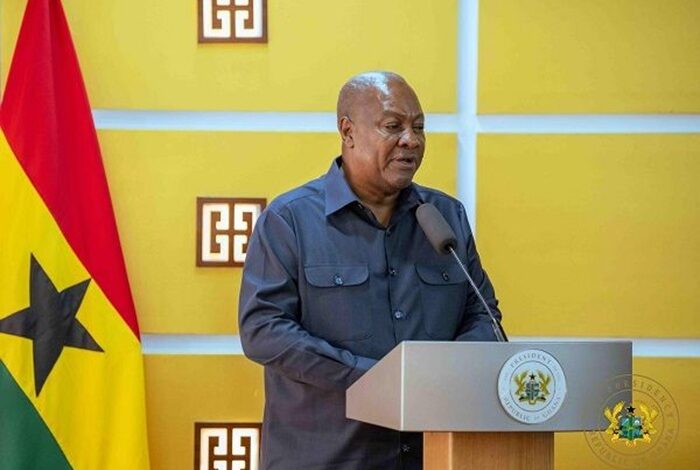
John Dramani Mahama has unveiled an ambitious national agenda aimed at transforming Ghana’s industrial landscape, setting a target for manufacturing to contribute at least 15 percent to Gross Domestic Product by 2030. The pledge, which represents a significant increase from the sector’s long-standing 10 percent share, is tied to a broader plan to generate 500,000 quality industrial jobs within the same period.
Speaking to business leaders in Accra, the President observed that Ghana’s manufacturing performance has remained largely unchanged for more than five decades. During that time, he noted, the sector has consistently hovered around 10 percent of GDP, despite shifts in global trade and industrial expansion across developing regions.
He contrasted Ghana’s trajectory with that of several emerging Asian economies which, starting from comparable industrial bases decades ago, have since expanded manufacturing to account for between 20 and 30 percent of their GDP. According to the President, this divergence underscores the urgency of structural reforms to reposition Ghana competitively.
Without decisive action, he cautioned, Ghana risks losing further ground not only globally but also within West Africa. He referenced a recent report by the Ghana Chamber of Mines indicating that the country is steadily losing investment competitiveness to neighbouring economies such as Benin, Côte d’Ivoire, and Nigeria.
The President identified high electricity tariffs, persistent power supply instability, import duties on machinery, and corporate tax burdens as major constraints inhibiting industrial expansion. He stressed that no country has successfully industrialised under conditions of structurally high energy costs, describing affordable and reliable power as fundamental to manufacturing growth.
To address these challenges, the government plans to accelerate energy sector debt restructuring, expand renewable energy generation capacity, and introduce differentiated off-peak electricity tariffs tailored for industrial users. Measures to improve transmission efficiency are also expected to form part of the broader energy reforms.
In addition, the administration intends to expand access to long-term industrial financing through partnerships involving the Bank of Ghana and development finance institutions, with the aim of easing capital constraints faced by manufacturers.
The President emphasised that the proposed interventions are not minor policy adjustments but comprehensive structural reforms designed to alter the country’s economic trajectory. Achieving the 15 percent manufacturing target, he concluded, would strengthen Ghana’s position as a competitive manufacturing hub within the West African sub-region and create sustainable employment opportunities for its growing workforce.