Ghana to Become Africa’s 8th Largest Economy in 2026
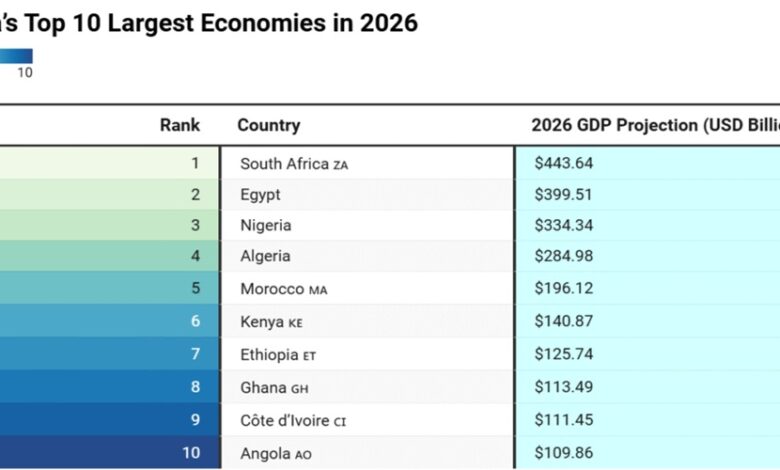
Ghana is projected to rank as the eighth largest economy in Africa in 2026, with a Gross Domestic Product (GDP) estimated at approximately US$113.49 billion, reflecting steady economic expansion and strengthening macroeconomic fundamentals.
The projected figure represents a moderate increase from an estimated US$108.1 billion recorded in 2025, underpinned by a forecast growth rate of 4.8 percent. The outlook aligns with broader projections by institutions such as the PwC and the International Monetary Fund, both of which have highlighted Ghana’s ongoing recovery and resilience despite external and structural challenges.
Ghana’s expected rise in the continental ranking underscores its ability to maintain relative macroeconomic stability while navigating public debt pressures, exchange rate volatility, and global financial tightening conditions.
The country’s economic structure remains relatively diversified compared to many of its West African peers. While traditional exports such as gold and cocoa continue to play a dominant role in foreign exchange earnings, the oil and gas sector has increasingly contributed to GDP growth and fiscal revenues. This diversification has helped cushion the economy against commodity price fluctuations.
In addition, sustained investments in infrastructure including roads, ports, and energy, have improved the overall business environment, enhanced productivity, and reduced operational costs for firms. These developments are gradually positioning Ghana as a competitive destination for investment and industrial expansion within the sub-region.
Globally, Ghana’s services sector continues to expand, supported by growth in banking, telecommunications, and trade. The industrial sector, particularly manufacturing and construction, is also showing signs of recovery, driven by policy reforms and private sector participation.
Despite these gains, analysts caution that Ghana remains vulnerable to external shocks, especially fluctuations in global commodity prices and tightening international financial conditions. Maintaining fiscal discipline, strengthening domestic revenue mobilisation, and building economic buffers will be critical to sustaining growth momentum.
Across the continent, South Africa is projected to retain its position as Africa’s largest economy in 2026, with a nominal GDP of about US$443.64 billion, followed by Egypt at US$399.51 billion and Nigeria at US$334.34 billion.
Ghana’s anticipated ranking among Africa’s top ten economies reflects not only its growth trajectory but also its strategic importance in regional trade, investment, and industrial development.
As reforms continue and key sectors expand, the country is expected to consolidate its position as one of Africa’s most resilient and promising economies in the years ahead.