

President Mahama ends 30-Year Foreign Cocoa Loan Regime
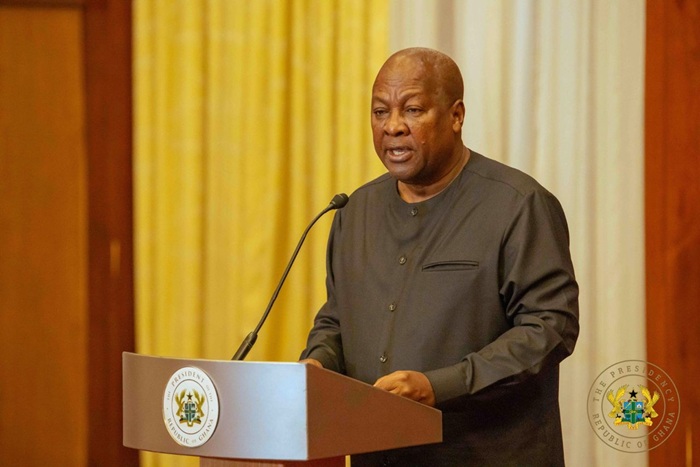
President John Dramani Mahama has announced that Ghana will end its three-decade reliance on foreign syndicated loans to finance cocoa purchases, declaring a major policy shift toward domestic bond financing.
Speaking at the Accra Reset – Addis Reckoning forum on the sidelines of the African Union Summit, President Mahama described the existing funding model as a structural constraint that has undermined Ghana’s industrial ambitions.
“To buy cocoa from our own farmers, we rely on funding from outside, and you know what the collateral for the funding is, our own cocoa beans. So you have to collateralise the beans to the financier, buy the beans, and just ship them, and they pay you the international market price,” the President said.
He continued: “One of the key decisions we’ve taken is that we’re going to stop foreign funding for the purchase of our cocoa. We are going to raise domestic bonds. We have enough cedis in Ghana to pay for our cocoa.”
For decades, Ghana has depended on dollar-denominated syndicated loans to pay cocoa farmers upfront. However, because the loans are secured against cocoa beans, the Ghana Cocoa Board (COCOBOD) has been obligated to export the raw produce to international financiers, even when local processors required supply.
President Mahama explained that the system recently proved costly during global market volatility, when cocoa prices dropped sharply from about $7,200 to $4,200 per tonne. The state, he noted, was left exposed to exchange rate risks and unable to adjust flexibly.
The President revealed that Ghana has the capacity to process up to 400,000 tonnes of cocoa locally but has struggled to feed factories because beans are effectively pre-sold under foreign-backed agreements.
“Now, if we buy the beans ourselves, we can take 400,000 tonnes out of the beans and give to our local processors to add value,” he said.
The new approach will see the government issue cedi-denominated domestic bonds to finance cocoa purchases, reducing exposure to currency shocks while keeping interest payments within the local financial sector.
President Mahama said the policy aligns with his broader economic reset agenda, aimed at strengthening fiscal sovereignty and boosting industrialisation.
The decision signals what he described as a decisive break from a “colonial” financing structure, positioning Ghana to retain more value from its cocoa industry and create thousands of jobs through local processing.



