Ghana Reference Rate for February Declines Marginally to 14.58%
By Praisebell Rosemond Larbi
The Ghana Reference Rate (GRR), a key benchmark used by commercial banks in pricing loans, has declined marginally to 14.58 per cent in February 2026, down from 15.68 per cent in January, raising expectations of a modest easing in lending rates across the banking sector.
The reduction reflects improvements in the core indicators used in calculating the Ghana Reference Rate, particularly following the Bank of Ghana’s recent monetary policy adjustment. The GRR serves as the baseline on which commercial banks price loans, with additional margins added based on borrower risk, operating costs and profit considerations.
Industry data show that three main variables shaped the February 2026 Ghana Reference Rate:
• 91-day Treasury bill rate: 11.19 per cent (end of January 2026)
• Interbank rate: 14.91 per cent (January average)
• Monetary Policy Rate: 15.5 per cent
Sources within the financial sector indicate that the recent 250-basis-point cut in the Monetary Policy Rate, which brought it down to 15.5 per cent, played a significant role in pulling the February GRR lower. The decline in Treasury bill yields and relatively stable interbank rates also contributed to the downward movement.
Market participants say the marginal drop suggests that interest rate transmission is gradually improving, although the pace of relief for borrowers remains measured.
Background to the Trend
The Ghana Reference Rate has been on a broadly downward trajectory over the past year, tracking the Bank of Ghana’s easing stance amid sharply falling inflation and improving macroeconomic stability.
The GRR was last reviewed downward on January 7, 2026, when it was cut from 15.9 per cent in December 2025 to 15.68 per cent. Prior to that, in December 2025, the rate fell to 15.9 per cent following a 350-basis-point reduction in the Monetary Policy Rate to 18 per cent, alongside a slight decline in Treasury bill rates.
In November 2025, however, the GRR rose marginally to 17.96 per cent from 17.86 per cent, reflecting temporary increases in both Treasury bill and interbank rates.
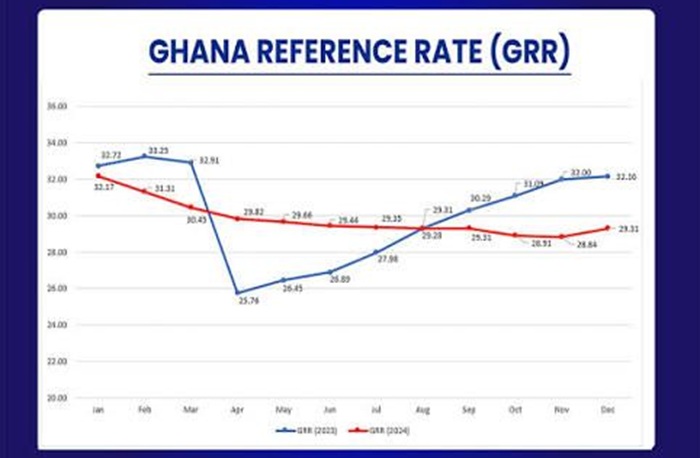
Over the course of 2025, the benchmark fell sharply from 29.72 per cent in January to 19.67 per cent by August, marking one of the most pronounced easing cycles since the introduction of the framework.
Purpose of the Ghana Reference Rate
The Ghana Reference Rate was introduced in 2017 by the Bank of Ghana in collaboration with the Ghana Association of Banks to improve transparency, consistency and fairness in loan pricing.
It replaced the previous base-rate system, which lacked uniformity across banks. The maiden GRR, announced in April 2017, stood at 16.82 per cent.
Implications for Borrowers and Businesses
The latest decline in the Ghana Reference Rate is expected to provide modest relief to borrowers, particularly those on variable-rate loans. Loans contracted in February 2026 are likely to be benchmarked against the new 14.58 per cent rate, potentially resulting in slightly lower interest charges compared to January.
However, borrowers on fixed-rate facilities will not benefit from the adjustment, while variable-rate customers will see changes depending on individual bank pricing models and risk premiums.
Commercial lending rates in January 2026 averaged around 22 per cent, suggesting that any reduction passed on to customers is likely to be gradual rather than dramatic.
Despite the easing trend, access to credit remains a major concern for businesses. President of the Ghana National Chamber of Commerce and Industry, Stephane Miezan, has warned that the biggest challenge facing enterprises is not only the cost of borrowing but the limited availability of credit.
He noted that tight liquidity conditions in the banking sector have contributed to the collapse of some firms, even as macroeconomic indicators continue to improve.
Analysts say sustained reductions in the Ghana Reference Rate, alongside improved liquidity and risk conditions, will be required before lending rates fall to levels that can meaningfully support private sector expansion and job creation.