GoldBod Boosts Sovereignty, Foreign Exchange — PreZ. Mahama
By Praisebell Rosemond Larbi
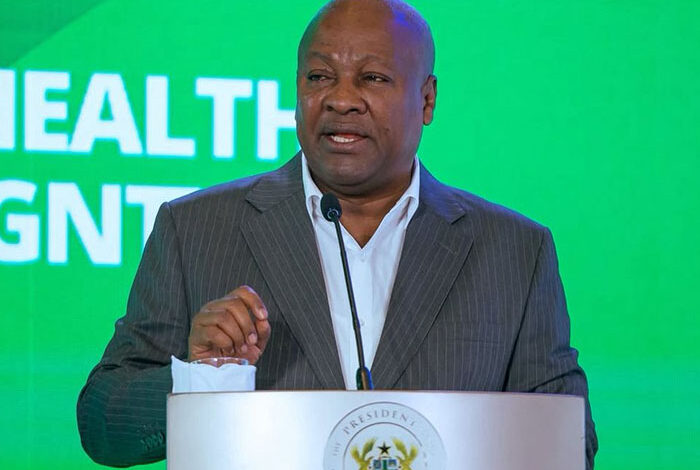
President John Dramani Mahama has hailed the Ghana Gold Board (GoldBod) as one of the most transformative reforms in the country’s natural resource governance, crediting the institution with boosting foreign exchange inflows, curbing large-scale smuggling, enhancing transparency, and strengthening Ghana’s sovereignty over its gold trade.
Addressing the Annual Conference of the African Association of Accountants General in Accra, President Mahama said the Board’s work demonstrates “the power of greater control over your natural resources,” noting that its establishment has corrected long-standing distortions in the sector while delivering tangible economic gains.
Prez. Mahama recounted the persistent challenges that plagued Ghana’s gold trade for years, particularly the unregulated activities of itinerant gold buyers who operated deep within mining communities. “We had people called gold traders who would go into the bushes and buy gold from our small-scale miners,” he said. The consequence, he noted, was significant discrepancies in export data, with reported shipments from Ghana failing to match receipts recorded in key trading destinations.
“There was a disparity in how much gold was reported to have been exported from Ghana and how much gold was received in India. We also found a disparity where a mining company’s figures of exported gold were different from the gold received by that same mining company in Canada,” the president explained.
These irregularities, he said, undermined state revenue, distorted export earnings, and facilitated massive capital flight. The decision to establish GoldBod, therefore, was intended to impose order on a chaotic system and restore national control. Under the Ghana Gold Board Act (Act 1140) passed in early 2025, GoldBod became the sole authority responsible for buying, assaying, and exporting all gold from Ghana.
President Mahama said the benefits were immediate and measurable. “The amount of foreign exchange that we get from the gold trade has suddenly jumped so high. It just shows what greater control of your natural resources can do,” he stated.
Stronger Oversight, Bigger Returns
Official data affirms the scale of the shift. Between February and May 2025 alone, GoldBod purchased and exported 41.5 tonnes of gold from small-scale miners, valued at approximately US$4 billion. This centralised, transparent approach has sharply reduced the illicit export routes that previously cost Ghana an estimated US$11.4 billion over five years.
The Board’s work has also boosted the country’s external buffers. According to the Bank of Ghana, national gold reserves climbed to 38.04 tonnes by October 2025, representing a 35% increase over the previous year. Analysts say these stronger reserves have helped stabilise the cedi and support ongoing monetary reforms.
Crackdown on Smuggling
Mahama emphasised that enforcement has been a critical pillar of success. Under the new regime, exporting gold outside GoldBod’s regulated channels is illegal and attracts “stringent penalties”. The combined efforts of the Board and security agencies have disrupted smuggling routes that historically served markets such as the UAE, where large quantities of undeclared Ghanaian gold were previously re-exported.
Enhancing Value for Small-Scale Miners
GoldBod’s reforms have also had a direct impact on small-scale miners by ensuring fairer pricing, proper documentation, and timely payments. CEO Sammy Gyamfi has said the structured system promotes traceability “from mine to export,” helping Ghana capture more value from its artisanal mining sector while reducing exploitation by informal middlemen.
Between January and September 2025, gold contributed US$11.2 billion to Ghana’s export revenues, underscoring its central role in stabilising household incomes, shoring up the currency, and supporting fiscal consolidation.
Resource Sovereignty at the Core
For President Mahama, the reforms reflect a broader continental message. “God blessed us with those natural resources, and we must use those natural resources to improve the lives of our people. Any country that has natural resources must increase its sovereignty in how those resources are exported or insist on value addition,” he said.
GoldBod, he argued, has become a model for how African states can reclaim control over extractive sectors long dominated by informal networks and foreign interests.