

IMF projects 4% growth for Ghana in 2025
The International Monetary Fund (IMF) has projected that Ghana’s economy will expand by 4.0 per cent in 2025, a growth rate slightly below the government’s target of 4.4 per cent outlined in the 2025 national budget.
This forecast was contained in the IMF’s Global Economic Outlook Report, released on the sidelines of the Annual IMF and World Bank Meetings in Washington, D.C.
According to the Fund, Ghana’s economy is expected to gain further momentum in 2026, when growth is projected to rise to 4.8 per cent, supported by continued macroeconomic reforms and fiscal discipline under the IMF-supported programme.
Ghana’s economy grew by 6.3 per cent in the second quarter of 2025, largely driven by the services sector, which expanded by 9.9 per cent and remained the biggest contributor to the country’s Gross Domestic Product (GDP).
Although the IMF did not explicitly outline the factors behind its projection, sources close to the Fund told Joy Business that the outlook reflects Ghana’s progress in implementing structural reforms, stabilising its currency, and rebuilding fiscal buffers.
However, the IMF’s forecast is slightly lower than the World Bank’s projection of 4.3 per cent, as contained in the Bank’s Africa Pulse Report released earlier this month.
IMF’s Inflation Outlook for Ghana
The IMF projects that Ghana’s end-of-year inflation rate will average 12 per cent in 2025, marginally above the government’s target of 11.9 per cent.
This comes despite the country’s significant progress in taming inflation, which dropped sharply to 9.4 per cent in September 2025, down from 21.5 per cent a year earlier.
The Fund’s inflation forecast makes it the second major institution, after the World Bank, to express scepticism about Ghana maintaining single-digit inflation through year-end. The World Bank, in its October report, projected 15.4 per cent inflation for Ghana in 2025.
Despite the differing projections, the Bank of Ghana remains confident that inflation will stay within single digits by December 2025, citing improved exchange rate stability, prudent monetary policy, and easing global commodity prices.
The IMF expects further disinflation in 2026, with inflation projected to decline to 9.4 per cent.
Global Economic Context
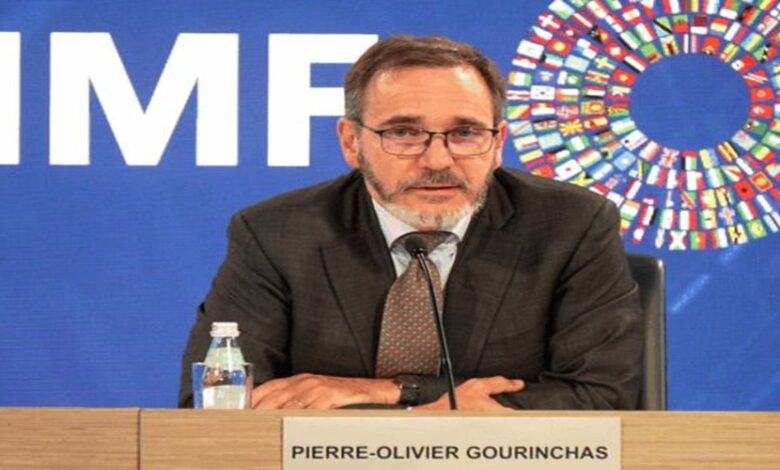
Commenting on the report, Pierre-Olivier Gourinchas, IMF Director of Research, said emerging and developing economies such as Ghana remain exposed to global uncertainties despite signs of steady recovery.
He urged countries to strengthen fiscal buffers and maintain policy flexibility to withstand external shocks.
The IMF also forecasts global economic growth to slow from 3.3 per cent in 2024 to 3.2 per cent in 2025, with advanced economies growing by 1.5 per cent, while emerging and developing countries, including Ghana, are expected to expand by an average of 4.0 per cent.



