

IFS urges gov’t to mobilise youth for large-scale rice farming
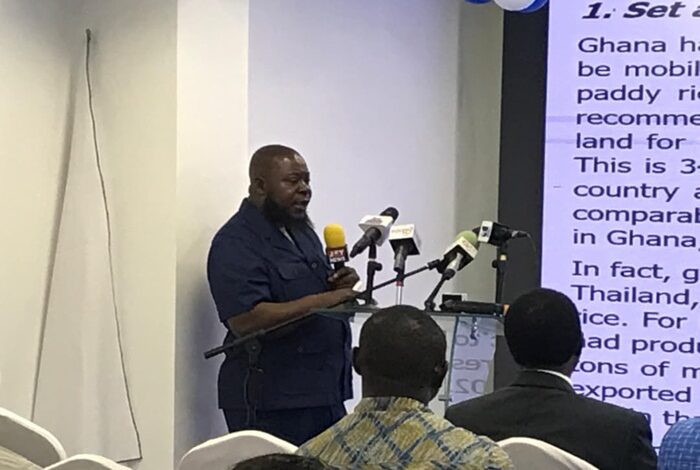
The Institute for Fiscal Studies (IFS Ghana) has presented a study on Ghana’s rice sector, entitled ‘Increasing Importation of Rice in Ghana: Can the Country Transform Its Fortunes in the Rice Sector?’ to a gathering of stakeholders in Accra on Wednesday, 15 October 2025.
The Institute aims to use the engagement to reinvigorate efforts to transform the rice sector, as well as the broader agricultural economy, to drive the country towards satisfying its basic food needs with reduced reliance on imports.
The presentation focused on government strategies to stem rice importation in Ghana and examined the causes of the growing dependence on imported rice, with comparisons to Vietnam and Thailand, alongside an analysis of policy interventions.
Ghana has seen sharp increases in rice consumption over the years, as the grain has become a key staple food, particularly among urban dwellers.
Data from the Ministry of Food and Agriculture (MoFA) show that yearly per capita consumption of rice increased from 12.4 kg in 1980 to 14.5 kg in 2000.
In the 2000s, consumption began to accelerate. By the end of 2010, per capita consumption had reached 32 kg, and by the end of 2022, it had risen to 61.05 kg.
Due to the inability of domestic rice production to meet demand, importation has long been a serious concern for government, with implications for the balance of payments, exchange rate stability and food security.
The presenter at the event, Dr Boakye, Senior Research Fellow and Acting Executive Director of the Institute for Fiscal Studies, expressed satisfaction that the presentation addressed many of the concerns raised by stakeholders in rice farming.
If you subsidise inputs, provide incentives, offer tax reliefs and actively get involved in provisions, all these issues will be addressed. That is exactly what IFS is talking about,” Dr Boakye said.
To discourage rice importation, government policy has generally focused on increasing local production to substitute for imports.
However, the strategy has become more direct and targeted since 2008.
IFS Ghana recommends that the government should mobilise the youth into rice farming on a large scale, stating that this would significantly expand production and position Ghana as a major net exporter of rice.



