Ghana studies Singapore’s model for efficient waste management
By Praisebell Rosemond Larbi
Ghana is seeking to learn from Singapore’s highly efficient waste management system, which has achieved a 100 per cent waste collection rate through strict regulation, technological innovation and community responsibility.
Officials from Singapore’s National Environment Agency (NEA), the body under the Ministry of Sustainability and the Environment (MSE) responsible for maintaining a clean and sustainable environment, revealed that all waste generated by the country’s six million residents is collected daily, leaving no refuse unaccounted for.
According to Halmie Hussien Mattar, Director of the Environment Technology and Industry Development Division at the NEA, Singapore’s approach to waste management is anchored on strategic planning and strict enforcement, particularly because of its limited land space.
He explained that three public waste collection companies have been contracted to ensure that no solid waste remains uncollected, noting that sanitation is treated as a national priority.
“We take it seriously. If we are unable to manage waste, then we will not be able to keep Singapore clean. Waste management in Singapore is about keeping our environment clean, maintaining high standards and ensuring sustainability in the process,” Mr Mattar said.
He revealed that the Semakau Landfill, Singapore’s only remaining landfill site, is projected to reach full capacity by 2035, prompting authorities to adopt proactive strategies to manage future waste challenges.
“Our Semakau Landfill will get full in 2035, and when that happens, how do we find the next alternative? Because we may not find one easily, we are already working toward a solution. Everything is centred around that,” he noted.
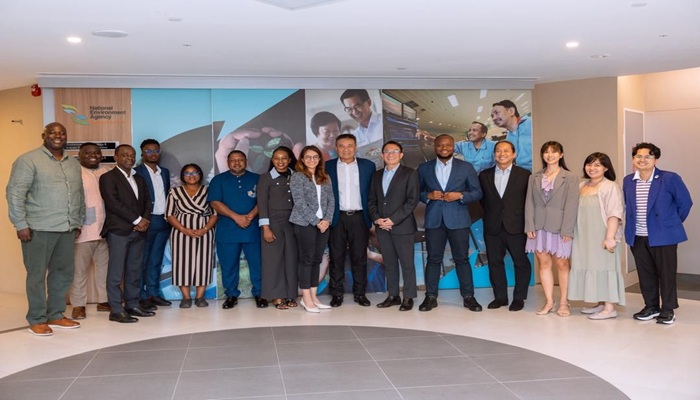
Mr Mattar made the remarks during an engagement with top executives of the Jospong Group of Companies, Ghana’s leading waste management conglomerate, which is exploring Singapore’s model as a blueprint for achieving nationwide sanitation efficiency.
On his part, Dr Peter Dagadu, Managing Director of Waste Landfill Company, a subsidiary of the Jospong Group, said Ghana could replicate Singapore’s model if every household was equipped with a functional waste bin and subscribed to a formal waste collection service.
“One of the key lessons from Singapore, which we’ve been reiterating in Ghana, is that every household must have a waste bin. This will ensure accountability and proper tracking of waste collection and disposal.
“Once a household has a bin, there’s a higher guarantee that the waste will end up in the right place. That’s what Singapore is doing well, and that’s why their waste collection efficiency is nearly one hundred per cent,” Dr Dagadu stressed.
He emphasised that local assemblies must strictly enforce by-laws requiring every household to own a waste bin, a measure he said was crucial to formalising Ghana’s waste collection chain.
Meanwhile, Dr Priscilla Addo, Operations Manager of the Sunyani Integrated Recycling and Compost Plant Limited (IRECoP), emphasised the need for public sensitisation and waste segregation education at the community level.
“The assemblies must identify people who pick up refuse informally in their communities. These individuals can be brought into the formal system, educated and trained on best practices for waste collection,” she stated.
Dr Addo added that waste collectors could be trained to understand the value of recycling, adding that plastics collected could be transformed into useful items such as reflectors and socks, turning waste into a valuable economic resource.