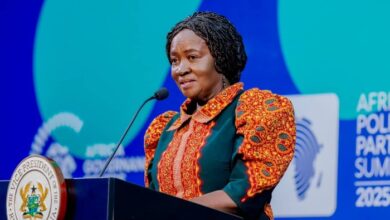
Gov’t reaffirms support for women in agribusiness

The Minister for Trade, Agribusiness and Industry, Elizabeth Ofosu-Adjare, has reaffirmed government’s commitment to empowering women in agribusiness as a cornerstone of Ghana’s economic transformation agenda.
Speaking at the Brong Ahafo Women Co-operative Cocoa Farming and Marketing Central Union (BAWCOF) Annual Festival in Techiman, Mrs Ofosu-Adjare commended the Union for championing women’s empowerment and promoting sustainable cocoa production under the theme “Nourishing Women, Cultivating Lives.”
Since its establishment in 2021, BAWCOF has supported more than 7,000 rural women cocoa farmers across nine cocoa districts, strengthening their capacity in co-operative marketing, leadership, and sustainable production.
The Minister said the Union’s success aligns with government’s goal of building resilient agribusiness value chains that generate jobs and increase productivity.
Mrs Ofosu-Adjare explained that restructuring the Trade Ministry to include Agribusiness and Industry was a strategic step to create stronger linkages between the production and processing sectors, positioning women as central players in Ghana’s industrial growth.
She outlined several flagship initiatives, including the Feed the Industry Programme, which aims to raise factory capacity utilisation from 30 per cent to 80 per cent by directly linking smallholder farmers, especially women, to agro-processors through structured supply contracts.
Government interventions, she said, also include tax incentives for agro-processing machinery, support for local equipment manufacturing through the GRATIS Foundation and the Rural Enterprise Programme, and value-chain financing under the Ghana Incentive-Based Risk-Sharing System for Agricultural Lending (GIRSAL).
She added that ongoing investments in cold-chain infrastructure could generate nearly USD 900 million annually from the fruits and vegetables sector alone.
The Minister further revealed that her Ministry is finalising a National Agribusiness Policy to integrate value chains, promote inclusiveness, and ensure that women farmers and agripreneurs have a strong voice in national policy formulation.
During her visit, Mrs Ofosu-Adjare toured an agribusiness exhibition and praised the creativity of women entrepreneurs. She also presented trophies to winners of a cooking competition, describing their innovation as “a symbol of the power of Ghanaian women to create value from the soil to the table.”
Minister for Food and Agriculture, Eric Opoku, also lauded women’s immense contribution to Ghana’s agricultural sector, noting that they account for 52 per cent of the agricultural labour force, 70 per cent of food production, and 90 per cent of processing and marketing activities.
He donated GHS40,000 to support BAWCOF’s operations and emphasised the need for value addition to maximise farmers’ income.
Mr Opoku said integrating agribusiness into the Trade Ministry was a decisive step toward ensuring that Ghanaian farmers benefit fully from their produce.
The festival drew hundreds of women farmers, co-operatives, traditional leaders, and industry stakeholders to celebrate achievements and explore new opportunities for inclusive, sustainable growth in Ghana’s agribusiness and cocoa sectors.