Nearly 8% of mobile money users in Ghana fall victim to digital fraud
By Praisebell Rosemond Larbi
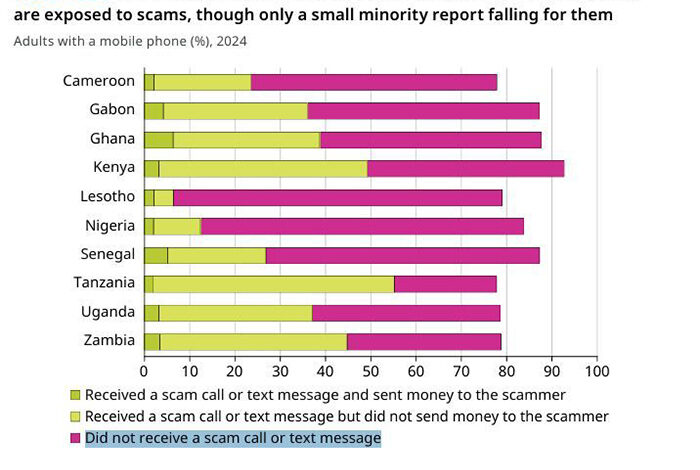
Almost 8 percent of Ghanaians who own mobile phones have fallen victim to digital fraud and ended up sending money to scammers, according to the newly released 2025 Global Findex Report by the World Bank.
The data reveals a troubling trend in the increasing vulnerability of mobile phone users to digital scams and extortion.
Specifically, the report notes that 32 percent of Ghanaian mobile users received a scam call or text message but did not send money, while 48 percent said they did not receive any scam-related communication at all.
The report, which surveys access to and use of financial services globally, warns that digital fraud is becoming a growing threat in developing economies, particularly in countries like Ghana, Gabon, and Senegal, where there is both high exposure to scams and a high tendency among victims to part with their money.
“In a few economies, however, mobile phone owners have both high levels of exposure to scams or extortion and a high tendency to send funds,” the report stated.
While mobile phone ownership has driven access to mobile money and online services in Ghana, the findings suggest that many users are not equipped with the knowledge or tools to detect and avoid fraudulent schemes.
These scams often take the form of fake investment opportunities, false mobile money reversals, impersonation of officials, or messages claiming prize winnings.
The 2025 Global Findex Digital Connectivity Tracker shows that although a relatively small share of users globally experience such scams, any level of exposure remains a serious concern. The report advocates for proactive education, legal reforms, and better consumer protection to tackle the issue.
No Gender Disparity in Scams But Risk Remains High
Contrary to some expectations, the report found no significant gender differences in scam exposure. Both men and women were equally likely to receive fraudulent communications and to send money in response.
However, the World Bank stresses the importance of targeted digital literacy training for vulnerable populations, particularly women, adolescent girls, and marginalized communities, to build resilience and awareness.
“Tailored training programs in digital literacy can help build preventive capacity by teaching users to recognize warning signs and employ privacy-enhancing settings on their mobile phones,” the report recommended.
Legal and Policy Gaps
The report also highlights global legal gaps in addressing digital fraud and cyber harassment. Out of 190 countries surveyed, only 53 economies have enacted laws that impose criminal penalties for cyber-related offenses, including scams, harassment, and extortion.
In response, the report recommends that legal frameworks be updated to recognize online harassment and digital scams as serious crimes comparable to physical offenses.
Furthermore, the World Bank calls for the creation of accessible and confidential reporting channels where victims can report incidents without fear of stigma. It emphasizes the need for transparent procedures in handling complaints to build trust and improve reporting rates.
International Response Efforts like the UN’s Global Digital Compact, which seeks to create principles for a secure and rights-respecting digital future, were cited as important steps toward global cooperation on online safety.