Book review: Dilemma of a Ghost, an outsider’s perspective
Story by: Olive Gibbon
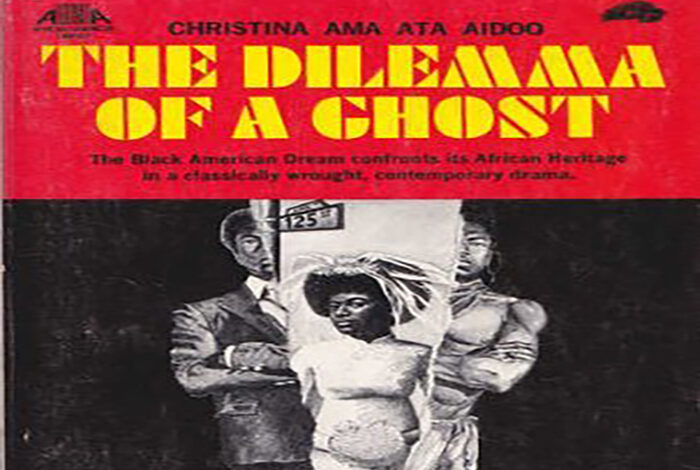
As a British visitor to Ghana, I have been amazed by the density of character and tradition in Accra, which is reflected in its literature too. Ama Ata Aidoo’s play ‘Dilemma of a Ghost’ highlights some of the tensions involved in mixing and attempting to negotiate between the at times individualized Western culture, and the social traditions of Ghana.
The play follows a Ghanaian scholar Ato’s marriage to a black American wife Eulalie, with her Coca-Cola and her “lovely sunhat”. Having met at University in North America, they return to Ghana with hope. Contrasting attitudes towards childbearing, infidelity, and exogamy (or marrying outside a community) arise through this encounter.
Ama Ata Aidoo achieves a great tension throughout the play, to reflect these cultural differences, particularly in dialogue. Dialogue between the married Eulalie and Ato is often stagnant and clunky with questioning, and honest and open communication is stunted. It felt like a lot of the play was taken up by characters not speaking their mind, creating a great sense of emptiness and absence that looms. The problem – Eulalie’s incongruence within Ato’s family – is never properly confronted, the tension is never released, reflected even by the setting of the courtyard that is “enclosed”, heightening the sense of inescapability of these differences that are not being properly recognized.
Eulalie’s indifference and ultimate rejection of Ato’s family clan’s social traditions will not be resolved with the silence the characters maintain. For Ato, “[no words come out]”. The naivety of the married couple to expect they can easily slip into the Ghanaian way of life has ramifications.
Ato’s mind also holds this cultural conflict. He dreams “that there were two children in this courtyard singing that song about the ghost who did not know whether to go to Elmina or to Cape Coast”, “But Uncle, the boy looked like me when I was a child”. This leads to perhaps the play’s climax, where [He looks bewildered and lost. Then suddenly, like an echo from his own mind the voices of the children break out]. By shifting from a sense of the real to the surreal, Aidoo creates a tragic image of a man removed from his sense of place.
However, Aidoo, I think, suggests that with the right conversations, the conflict these differences cause, are not inevitable. Eulalie’s shocking abusive language ruins chances of harmony, asking “Who married me, you or your goddam people?”, “Do you compare these bastards, these stupid narrow-minded savages with us? Do you dare…?”. Ato’s Mother tragically claims “your wife laughs at us because we do not understand such things…”, Eulalie cannot attempt tolerance of their differences, so a reconciliation cannot be achieved. As the wise women observe, in marriage “if both players are good, the game may end equally”, but this is not the case for the couple.
While Aidoo was writing in the 1960s, these themes feel stark to me as I am able to experience Ghana’s culture in comparison to my own. I am loving to allow these two cultures, of my home in England and my stay in Accra, to co-exist, rather than somehow contradict or conflict with each other. But I am most often recognising elements that are so similar – of family, fear, pain.
Aidoo’s play seems to call for an acceptance that cultural differences often don’t have to be reconciled, but can be acknowledged and confronted in order for relationships to work.
Aidoo’s play is therefore an honest one that I thoroughly enjoyed, it creates a space for sympathy towards all characters, who are each vulnerable in some way. It maintains a nuance to the presentation of change against tradition, prevalent in all lives today. As I navigate Accra, it has reaffirmed the necessity of an open mind towards difference, of tolerance and curiosity, and the importance of honest conversation, most importantly with who you disagree with, for people to try and understand one another.