

Doing good and making money (Part 1)

By Prof. Ernest Ofori Asamoah
NOT-for-Profit Organizations (NPOs) or Non-governmental Organizations (NGOs) are mostly set up to solve social, environmental, economic, spiritual or psychological needs in communities among others. NGOs and NPOs do not have the primary aim of making a profit (money).
They do not distribute profits arising from their activities to their members or founders, but use them for the pursuit of their objectives. Thus, the primary aim of not-for-profit institutions is to do good for society or solve societal needs.
The profit-making businesses, however, have primary objective of making profit even though they may attend to some societal needs through their corporate social responsibility or corporate social investment but that is not their primary objective.
Even with the advent of Environment, Social and Governance in businesses, the primary aim of businesses is to do business by generating profit (money). Social enterprise as a business model, however, provides a middle way of doing good (solving social and environmental challenges) and making money (profit objective).

Social Enterprise Business Model
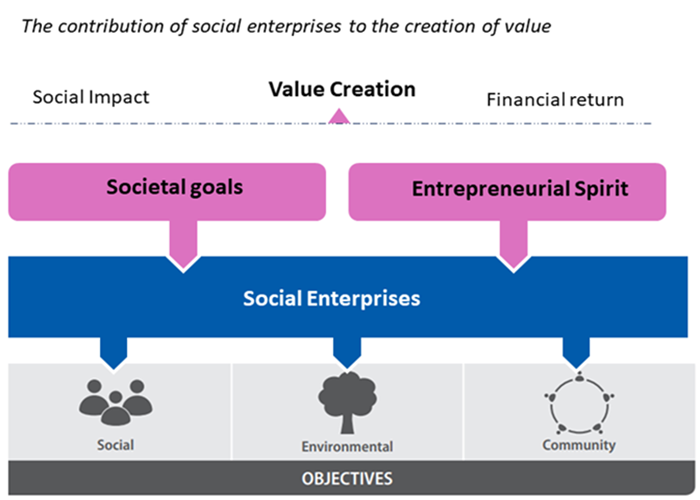
Social Enterprises are businesses that adopt business principles to solve social and environmental issues. In sum, they have social and environmental objectives as well as business objective.
There are three key attributes that generally define a Social Enterprise. These are the objectives of the business, entrepreneurship model and governance of the business. The main objective of a social enterprise business is to solve social or environmental need or challenge of the communities/society. These may be issue in healthcare, waste management, food security or environmental degradation or global warming etc.
The social objective should, in turn, be sufficient to motivate entrepreneurial ventures, and these ventures should be able to achieve economic independence and sustainability of the business. The business should be able to generate enough revenue to take care of operations rather than depending 100% or largely on grants and donations.
Finally, for a business to qualify as social enterprise, it should have inclusive and participatory governance because the focus is on the interest of the parties and beneficiaries involved and not the single interest of the owners or shareholders.
It is estimated that there are approximately 11 million social enterprises across the world. Social enterprises across the world take on a variety of legal forms. They range from operating globally to local impacts, and they work across all sectors of the economy; agriculture, heritage, education, health, food, arts etc.
Global Entrepreneurship Monitor (GEM) estimates the prevalence of people running and operating social enterprises at around 3.5% or 35 million people running Social Enterprise. Furthermore, 38% are estimated to have created more than 5 jobs and 57% of these are volunteer positions.
Social Enterprise Model in Different Jurisdictions
The British Council, in the context of their research carried out for social enterprises in Sub-Saharan Africa (SSA), defined social enterprise as a business that combines entrepreneurial activity with a social purpose. Its main aim is to have a social impact rather than maximize profit for owners or shareholders.
The European Commission (EC) considers a social enterprise as an operator in the social economy whose main objective is to have a social, societal, or environmental impact rather than make profit for the investors or owners. The EC uses the term ‘social enterprise’ to cover the following types of businesses:
- Businesses with a social or societal objective, often in the form of a social innovation;
- Businesses where profits are mainly reinvested to help achieve this social objective, and
- Businesses where the organisation or ownership reflects the mission, under democratic or participatory principles, or is focused on social justice.
The definition incorporates the three key dimensions of a social enterprise:
- Entrepreneurial Dimension: differently from traditional non-profit organizations/ social economy entities (pursuing a social aim and generating some form of self-financing, but not necessarily engaged in regular trading activity), social enterprises are engaged in continuous economic activity;
- Social Dimension: social enterprises have a primary and explicit social purpose, which distinguishes them from mainstream (for‑profit) enterprises;
Governance Dimension: social enterprises have mechanisms to ‘lock in’ the social goals of the organization, which distinguish them even more sharply from mainstream enterprises and traditional non-profit organizations/social economy entities.
In Europe, there are 2 million social enterprises, mostly micro, small, and medium-sized enterprises (SMEs), representing 10% of all businesses in the EU, more than 11 million people (about 6% of the EU’s employees) work in these enterprises and up to 160 million people in Europe are members of social economy enterprises.
SEs do not pay dividends to shareholders but re-invest profit or surpluses for community benefit or to expand the objects of the business or the company.
In Canada, there is no unified definition for a social enterprise, therefore it falls into a wide spectrum of business models.
A social enterprise does not have a specific corporate form; it includes “non-profit organizations” or “registered charities” that operate revenue-generating businesses. Furthermore, it encompasses organizations that operate as “for-profit” businesses with a social goal.
– Writer’s email: eoforiasamoah@gmail.com



