

Only 4% of SDGs on track for Africa by 2030
At the mid-point of the Sustainable Development Goals (SDGs) implementation timeline, recent progress reports reveal that only 4 percent of the goals are on track to be achieved by Africa by 2030.
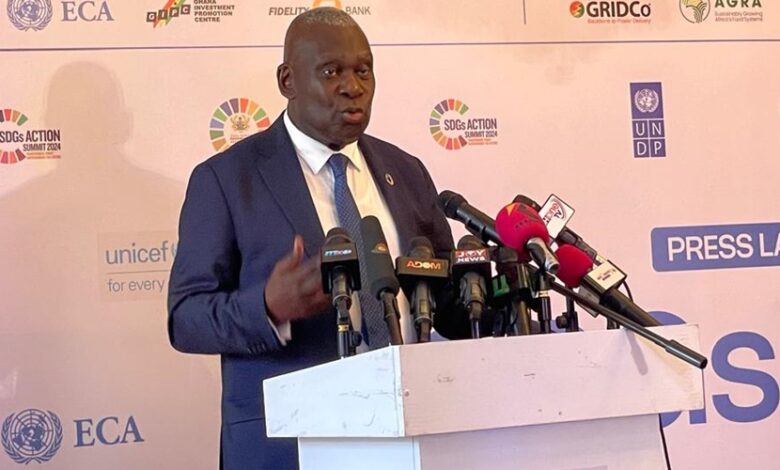
This was highlighted by Dr. Eugene Owusu, Special Advisor to the President on the SDGs, during the launch of the SDGs Action Summit 2024 in Accra on Monday.
Dr. Owusu warned that without accelerated and coordinated efforts, the continent risks missing key SDG targets.
He cited a 2022 joint report by the African Union Commission, the UN Development Programme, the UN Economic Commission for Africa (ECA), and the African Development Bank (AfDB) which concluded that without quicker progress, at least 492 million people in Africa will remain in extreme poverty by 2030.
“The slow progress on many of the goals and targets leaves the fate of millions of Africans and the fate of the planet in dire straits,” Dr. Owusu stated.
He outlined the multifaceted challenges impeding progress, including climate change, ongoing conflicts, lingering effects of COVID-19, policy failures, and a skewed global governance structure. These issues collectively pose a significant threat to the continent’s progress in achieving the SDGs.
“These challenges are reinforcing deprivation across the continent, exacerbating poverty, fueling instability, widening inequalities, and sharply contributing to the deteriorating health of our planet,” Dr. Owusu explained.
However, Dr. Owusu emphasized resilience and innovation as crucial tools for scaling up efforts to make progress toward achieving the SDGs. The SDGs Action Summit 2024, slated for July 2-3, aims to turbocharge actions and build a consensus on delivering outcomes.
“We continue to have abundant opportunities in the Sustainable Development Goals (SDGs) to address these challenges, foster inclusive and sustainable development across our continent, and give our world a fair chance of achieving global peace and stability, engender prosperity for all, and save our planet,” Dr. Owusu asserted.
The summit, to be held under the auspices of Ghana’s President, aims to prepare for the upcoming UN Summit of the Future by reigniting commitment and catalyzing bold actions. The theme, “From mid-point to Success – Recommitting, Scaling Up and Accelerating Action on the SDGs,” seeks to reverse current trends and foster a collective voice and robust call to action for the global community.
“The urgency of action on the SDGs cannot be overstated,” Dr. Owusu stressed.
He highlighted the high costs of failure, including economic stagnation, increased inequality, and environmental degradation, which are too significant to ignore. Despite the challenges, he expressed optimism about the continent’s potential to scale up implementation efforts.
“We have the resources, the know-how, and the capacity necessary to achieve the goals. With the opportunities that the SDGs present, we must be at our boldest, be creative and innovative, and leverage smart solutions to drive success,” he urged.
The Sustainable Development Goals are a global call to action to end poverty, protect the earth’s environment and climate, and ensure that people everywhere can enjoy peace and prosperity.
Charles Abani, UN resident coordinator in Ghana lauded Ghana’s progress so far in achieving the SDGs and pledged the UN’s continued support.
He emphasized that it is easy to end up viewing the 17 SDGs in silos, yet, many of the actions needed to achieve these goals do not fit neatly into these silos.
To address this, particularly in terms of finance, he said there is need for sustainable finance mechanisms where the governments must provide a regulatory framework to enable finance, offering assurances and predictability to encourage private sector involvement.
This involves leveraging various actors in different ways, such as pension funds, private investors, banks, and financial institutions.
He explained that the UN identifies six key transitions that cut across various sectors: food systems (encompassing nutrition, agriculture, employment, and social protection), and energy (ensuring affordable, accessible, and efficient supply).
He explained that effective energy systems enable businesses to thrive in production, value addition, and trade skills development for different sectors ensuring that Ghana is prepared for the future.
“Ghana is making significant progress and leading in many areas. For example, at the Transforming Education Summit in 2022, Ghana set clear priorities, which were further emphasized at the SDG Summit last year. Prioritizing TVET, STEM, and technical skills places Ghana at the forefront of education innovation”.
In terms of climate change, he note that the United Nations Development Programme has supported the Environmental Protection Agency , making it a learning hub for other African countries to leverage resources where many countries now look to Ghana for guidance.
“Ghana’s achievements are numerous, but as I mentioned To whom much is given, much is expected.” Adding that Ghanaians have a remarkable ability to rise to these expectations.



