Minister inaugurates Greater Accra Regional Lands Office

An ultra-modern office serving as the hub of activities for the Greater Accra Lands Commission has been commissioned by the Minister for Lands and Natural Resources, Samuel A. Jinapor.
The edifice comprised spacious office spaces, an auditorium and conference rooms, which would serve as a hub for land transactions and enhance efficiency in service delivery.
The state-of-the-art facility was funded with the Commission’s Internally- Generated Funds (IGF) and would accommodate the four Divisions: Survey and Mapping, Land Registration, Land Valuation, and Public and Vested Land Management.
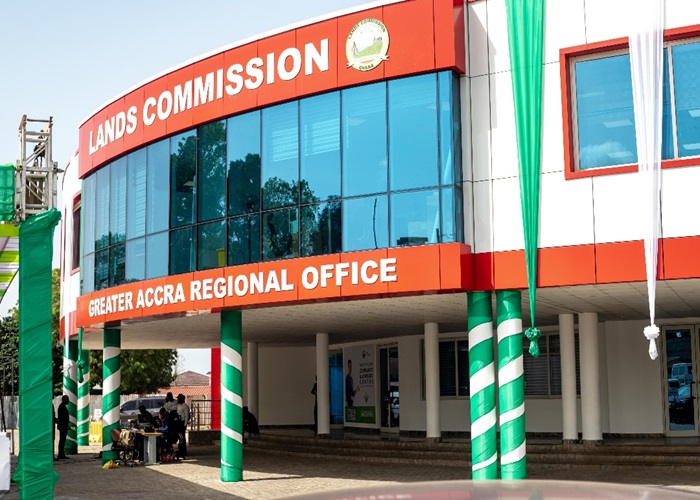
During the commissioning ceremony, Jinapor commended the management and staff for completing the first and second phases of the project.
He emphasized the cultural significance of land and its value to the country’s economic performance.
Recognizing land as pivotal to socio-economic development, he stressed the importance of an effective land administration system free from fraudulent activities and inefficiencies.
Jinapor addressed the specific case of the Greater Accra Region, highlighting its role as the busiest regional office in the country. He emphasized the need for effective delivery of land administration services by the management and staff to meet the demands of the region.
He highlighted the importance of land to the country’s socio-economic development, noting that all human activities revolved around it.
“Land is the fulcrum to the success of all sectors of the economy such as agriculture, mining, security, manufacturing, trade, education, transportation, infrastructure, energy, and health, among others.”
Mr Jinapor referenced data from the Ghana Statistical Service, which estimates that some 90% of the country’s population derived their livelihoods directly or indirectly from land.
He, therefore, underscored the need for an effective land administration to drive the nation’s progress and prosperity.
“The adverse consequences of ineffective, fraudulent and weak land administration is very damning,” he said.
“It is, therefore, not surprising that article 258 of our national Constitution establishes the Lands Commission to, among others, manage public lands, ensure effective registration of land, and formulate national policies for the administration and use of land.”
To ensure efficient administration, Mr Jinapor called for the need to equip and empower the Regional Lands Commission to perform their constitutional functions.
It was imperative to adapt and enhance the capabilities of the Commission to meet the demands of the modern era, he added.
The Lands Minister outlined major reforms and interventions by the government aimed at developing a robust and effective land administration system.
These reforms include decentralization and digitalization efforts to meet the evolving demands of the modern era.
At the heart of those reforms was the decentralisation of land administration, including the establishment of six fully digitised offices for the six new regions, and the roll out of satellite Client Service Access Units (CSAU) in all regional offices to bring services closer to the doorsteps of the public.
The facility, he said, was part of several projects being undertaken by the Commission to provide a conducive work environment for the staff and those who accessed its services.
“We are, also, implementing our Urban Redevelopment Scheme, under which 504 two-bedroom self-contained housing units, with a school complex, a clinic and a recreational area, had been constructed for the Ghana Police Service.”
Office complexes have also been constructed for the Driver and Vehicle Licensing Authority (DVLA), the Ghana Airport Company Limited and the Ghana Meteorological Agency.
That, he said, would pave the way for the redevelopment of the 80-acres of land between Stanbic Heights and the Ministry of Defence.
In addition to those developments, Mr Jinapor said the Government was pursuing an aggressive digitisation agenda, to digitalise the records of the Commission to promote a robust land administration that ensures peace, security, and economic growth.
Already, the Commission had successfully migrated some of its operations into the digital environment and rolled out the Enterprise Land Information System (ELIS), which offered some select services fully online.
“Today, a search in the Commission’s records can be conducted from anywhere in the world, and at any time of the day,” Mr Jinapor said.
“The introduction of the Electronic Property Mass Appraisal System (EPMAS) had facilitated the revaluation of properties in several Metropolitan, Municipal and District Assemblies (MMDAs) and, thus, boosting revenue drive.”
“Without a doubt, the Greater Accra Region holds a special place in land administration in our country. I am told it is the busiest Regional Office of the Commission.”
“It is, therefore, imperative that we provide a befitting office space that ensures the majority of our people who access our services get the best of service delivery.”
Mr. Benjamin Arthur, the Executive Secretary of the Lands Commission, highlighted the completion of the project as part of efforts by past and present management to provide conducive work environments for staff.
He assured of the Commission’s commitment to maintaining and utilizing the facility efficiently to support improved land service operations.
Lawyer Alex Quaynor, National Chairman of the Lands Commission, disclosed plans for a new office complex in Tema to cater to clients in the Eastern part of the Greater Accra Region. He emphasized that the construction of offices is part of measures to eliminate disruptions caused by individuals, particularly “goro boys,” and enhance service delivery.