Gold4oil procured 800,000 metric tonnes
-Of petrol, diesel in one year-Jinapor
By Elvis DARKO, Accra
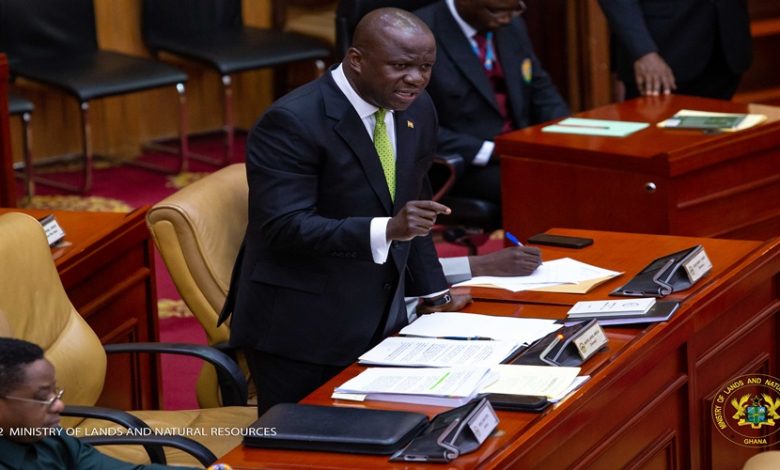
The Minister for Lands and Natural Resources, Samuel Abu Jinapor, has commended President Nana Addo Dankwa Akufo-Addo and Vice-President Dr. Mahamudu Bawumia for introducing the Gold4Oil Policy.
He praised the innovative measure during a parliamentary debate on the 2024 Budget Statement and Financial Policy of the Government, stating that it played a crucial role in stabilizing the local currency and reducing the cost of fuel.
The Gold4Oil Policy, introduced in response to the depreciation of the Ghana Cedi in late 2022, involves purchasing crude oil without dollars.
The programme required large-scale mining companies to sell 20% of their refined gold to the Bank of Ghana, with small-scale mining companies required to sell all their gold to the Bank of Ghana.
The Bank of Ghana then used the locally purchased gold to buy crude oil.
Over 800,000 metric tonnes of gasoline and gasoil, representing almost 30% of Ghana’s total crude oil consumption, were purchased through the Gold4Oil Policy within one year of its implementation.
According to the Finance Minister, the policy contributed to stabilizing the Ghana Cedi, bringing it down from GH₵17 to a dollar in November 2022 to GH₵12 to a dollar in November 2023.
It also led to a reduction in petrol prices from GH₵23 per liter to GH₵12 per liter.
The government intends to scale up the programme to cover 50% of national consumption.
Mr Jinapor who is the Member of Parliament (MP) for Damongo in the Savannah Region emphasized the leadership skills of the President and Vice-President in making bold choices during times of adversity.
“In times of crisis, what is required is leadership as it relates to choices, and the President and the Vice-President made bold choices that have impacted our economy,” the Minister said.
He highlighted the significance of the Gold4Oil Programme in shoring up the Bank of Ghana’s reserves and noted the government’s commitment through the Ministry of Lands and Natural Resources to scaling up gold production to support the programme.
The Minister stated that the implementation of the Programme, alongside the Domestic Gold Purchase policy, has shored up the Bank’s reserves.
Additionally, Mr Jinapor discussed the mining sector’s contribution to the economy, noting that it contributes almost 9% of Gross Domestic Product (GDP), with gold alone contributing $4.67 billion in exports as of August 2023 representing 43.4% of total exports this year.
He highlighted the government’s efforts to boost production by developing new mines and expanding existing ones, along with investments in exploring green minerals like lithium, graphite, manganese, and bauxite to support the green energy transition.
Mr. Jinapor, also, touted the mining lease granted for the exploitation of lithium, which provides for value addition, increased royalties and local participation, saying it is one of the best in the world.
He said government is also investing in the exploration of other green minerals like graphite, manganese and bauxite to support the green energy transition.
The Minister said these and several other measures being implemented by government will contribute to achieving the One Trillion economy targeted by government.
In response to allegations about United Nations Educational, Scientific and Cultural Organization’s (UNESCO) buildings being sold and the sale of the Clerk of Parliament’s official residence, Mr Jinapor denied the claims and cautioned against making sweeping statements without verification from the Lands Commission.
He, also, clarified that the Clerk of Parliament’s official residence alleged to have been sold in 2019, was actually sold in 2015.
The parliamentary debate on the 2024 Budget is scheduled to conclude on Tuesday, November 28, 2023.
Gold for oil programme explained in 14 points
- The implementation of the government’s Gold for Oil (G4O) programme commenced with the arrival of the first consignment of about 40,000 metric tonnes of diesel on January 15, 2023, valued at about $40 million.
- The prime objective of the programme is to use additional foreign exchange resources from the Bank of Ghana’s Domestic Gold Purchase(DGP) programme to provide foreign currency for the importation of petroleum products for the country which currently stands at about $350 million per month.
- Payment for oil supply is to be done in two channels: by way of barter trade where gold is exchanged for oil or via broker channel where the gold is converted into cash and paid to the supplier.
- The first consignment of 40,000 metric tonnes of diesel constitutes about 10 percent of the country’s combined monthly demand for petrol and diesel.
- The plan is to gradually increase imports under G4O to constitute about 50% of the country’s total demand of petrol and diesel by March 2023.
- The implementation of the G4O will ease pressure on the dollar (the currency used for the importation of petroleum products) and avoid the occasional increases in petroleum prices resulting from the depreciation of the cedi against the dollar.
- The programme will ensure that the cost of importing the products from international oil traders to be comparatively cheaper.
- The consequent reduction in foreign exchange pressures and premiums charged by international oil traders as well as efficiency gains from the value chain will lead to lower ex-pump prices in the country.
- To ensure that the price of petroleum products imported under the G4O programme reflects at the pumps to benefit the consumer, the National Petroleum Authority (NPA) will regulate the prices of the products in the interim until the volumes increase significantly.
- NPA will work with Bulk Oil Storage and Transportation Company Limited (BOST) to negotiate prices with the international oil traders to ensure that the landed cost of products procured under the programme are always competitive.
- The price at which BOST will sell the products to Bulk Import, Distribution, and Export Companies (BIDECs) will be approved by the NPA. The price at which the BIDECs will sell the products to Oil Marketing Companies (OMCs) will also be approved by the NPA.
- The applicable exchange rate for pricing the products supplied under G4O will be based on the average rate at which the gold was purchased from the licensed gold exporters by BoG.
The BoG ordinarily purchases the gold aggregated by the Precious Minerals Marketing Company (PMMC)
- The NPA will put measures in place to ensure that OMCs that lift products supplied under the G4O programme pass the price on to consumers accordingly. In this respect, BIDECs and OMCs who lift and supply G4O products will sell at the ex-refinery and ex-pump prices that will be determined by the NPA. If there must be a comingling of products supplied under G4O and other sources, the ex-refinery and ex-pump prices will be computed using a weighted average.
- All BIDECs and OMCs who wish to purchase products under the G4O programme will be required to sign off an undertaking confirming their willingness to comply with the terms and conditions for partaking in the purchase and sale of G4O products.