Govt introduces guidelines to enhance fiscal prudence during emergencies
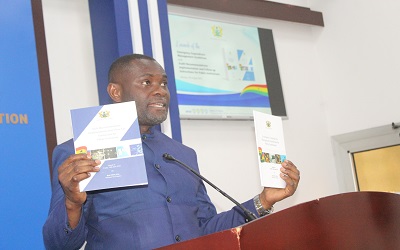
The Ministry of Finance and Economic Planning (MOFeP) has launched a couple of documents to streamline how government agencies act financially during emergencies and how they implement audit reports.
The two reports are the Emergency Expenditure Management Guidelines for Public Institutions and the Audit Recommendations Implementation and Follow-up Instructions for Public Institutions.
The reports were launched by the Deputy Minister of Finance, Dr John Kumah, on behalf of Ken Ofori-Atta yesterday, at the Ministry of Information.
He indicated that the launch of the documents is meant to provide a clear, transparent framework for how the nation responds to crises and upholds fiscal discipline in public emergencies as well as improve public accountability.
With reference to the specific documents, he noted that the “Emergency Expenditure Management Guidelines, were created in response to recent challenges, including the global pandemic that tested the resilience of our country’s ability to respond effectively to the impact of the Covid-19 pandemic whiles complying with the requirements of the Public Financial Management (PFM) Act.”
It will also “present procedures and internal controls that will direct service delivery units on the means to access, manage, and account for funding during an emergency with efficiency and transparency, whiles ensuring compliance with the various requirements of the PFM laws,” he said.
The Audit Recommendations Implementation and Follow-up Instructions for Public Institutions on the other hand are anchored on government’s firm commitment to ensure strict accountability and transparency in the management of public resources.
They provide clear guidelines for handling and following up on audit recommendations by various stakeholders by providing procedural clarity and delineating the roles and responsibilities of relevant stakeholders.
The development of the two documents was occasioned by lessons learnt from the nation’s experience during the COVID-19 pandemic.
The Deputy Finance Minister stated that it is the expectation of government that with the effective use of this guideline there will be improvements in the implementation of audit recommendations and ultimately a reduction in audit infractions.
He said, “Ultimately, our collective ambition must be to create an environment where every financial decision is made with integrity, and where mistakes are not only identified but rectified.”
Dr Kumah revealed that in the run up to the 2023 Mid-Year Budget, a review of the annual statements submitted by covered entities in 2022 demonstrated that a total of 4,641 audit recommendations were reported.
Due to strong follow-up actions, 3,144 of the recommendations, representing 68%, have been completely implemented, while 1,056 of the recommended actions representing 23% are ongoing, and another 441 actions of the recommendations (9%) are yet to be implemented.
Director General of the Internal Audit Agency (IAA), Dr Eric Oduro Osae, was optimistic that the development of these two frameworks will improve the nation’s Public Financial Management System.
He further noted that the launch of these documents is in keeping with the renewed transparency and accountability that the Minister promised to bring to public financial management in the 2023 Budget.
Dr Osae said these new frameworks will help the IAA keep track of, and follow the implementation of audit recommendations and help the Agency record zero irregularities in the during audits.
He also declared that there had been a decline in the infractions in the use of the District Assemblies Common Fund and the statutory funds by about 19%.
There has also been a 30.6% decrease in the operations of Municipal, District, Assemblies (MDAs).
Also reduced are irregularities in the activities of Colleges of Education and Pre-University educational institutions by about 58.6%.
The same was reported in the activities of public corporations and other statutory institutions by 13.8%, saving the country about GH¢2.4 billion.