

Ghana-Canada trade hits $752m
Trade between Ghana and Canada recorded a significant boost in 2025, with the value of bilateral merchandise and services exchange rising by 56 per cent year-on-year to US$752 million, underscoring the growing shift in relations between the two countries towards trade and investment.
The latest figure was announced by the Canadian High Commissioner to Ghana, Ms Myriam Montrat, during Canada’s 159th National Day reception in Accra. She said the strong growth reflects expanding commercial engagement and growing opportunities for businesses in both countries.
“Through trade and investment, Canadian companies are contributing expertise, technology and innovation to Ghana’s development. In 2025, trade between Canada and Ghana reached $752 million, a 56 percent increase,” she said.
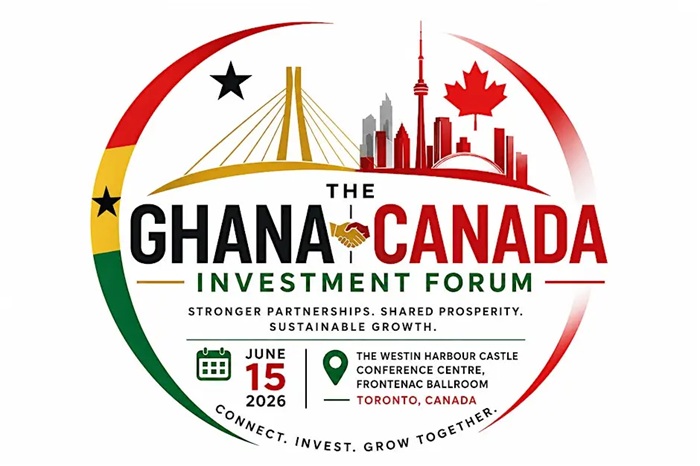
According to the High Commissioner, the increase demonstrates the untapped potential for stronger economic ties between the two countries. She disclosed that Canada will host an Investment Summit later this year to showcase investment opportunities and reduce risks for international investors, including businesses from Ghana.
The latest trade performance comes against the backdrop of a changing economic relationship between Ghana and Canada. While cooperation between the two countries has traditionally centred on development assistance, technical support and capacity building, recent years have seen a deliberate shift towards deeper commercial partnerships driven by private sector investment and trade.
Since establishing diplomatic relations in 1957, shortly after Ghana gained independence, the two countries have collaborated extensively in areas such as education, healthcare, governance, agriculture, water and sanitation, mining and clean energy. However, evolving economic priorities in both countries have increasingly placed greater emphasis on investment, industrial growth and export expansion.
Canada’s renewed focus on strengthening economic engagement across Africa, coupled with Ghana’s strategic position as host of the Secretariat of the African Continental Free Trade Area (AfCFTA), has further strengthened prospects for bilateral trade and investment.
Current trade flows illustrate the complementary nature of both economies. Canada’s exports to Ghana largely comprise higher value manufactured products, including cereals, machinery, transport equipment, pharmaceuticals and other industrial goods. Ghana’s exports to Canada, on the other hand, remain dominated by primary commodities such as cocoa and cocoa products, gold, soya beans and other agricultural produce.
The existing trade structure presents opportunities for both countries to deepen cooperation in value addition, manufacturing, agribusiness processing, renewable energy and digital services as efforts continue to diversify exports and strengthen participation in global value chains.
The implementation of the AfCFTA is also expected to create fresh opportunities for Canadian businesses seeking access to African markets through Ghana. With the continental trade agreement providing access to a market of about 1.4 billion people, Ghana is increasingly positioning itself as a preferred destination for investment into sectors including manufacturing, infrastructure, renewable energy, agribusiness, digital technology and responsible mining.
“The AfCFTA creates a new investment thesis for Canada in West Africa,” Dr. John Abdulai Jinapor, the Minister for Energy and Green Transition, said.
Dr Jinapor said Ghana welcomes the evolution of its relationship with Canada from one centred largely on development cooperation to one driven by trade, investment, innovation and sustainable economic growth.
“The longstanding partnership has contributed to Ghana’s development through cooperation in trade, mining, clean energy, water supply, agriculture, science, education and technical assistance. We are now pursuing a relationship based increasingly on commercial viability, technology transfer, and capital formation,” he said.
He added that expanding collaboration in agribusiness, renewable energy, manufacturing, digital transformation, infrastructure and responsible mining has the potential to create jobs, strengthen industrial development and promote inclusive economic growth.
Beyond economic cooperation, both countries reaffirmed their commitment to continued collaboration in areas including climate action, peace and security, education and multilateral engagement.
With bilateral trade reaching its highest level to date and both governments signalling stronger support for investment and regional integration under the AfCFTA, analysts expect commercial ties between Ghana and Canada to continue expanding over the medium term, supported by higher investment inflows and stronger integration into regional and global value chains.



