

ECOWAS Targets Rice Self-Sufficiency by 2035
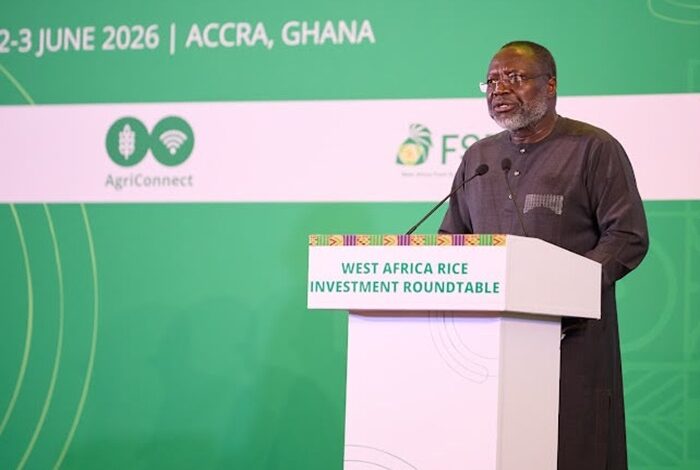
The Economic Community of West African States (ECOWAS) has set a target of achieving rice self-sufficiency by 2035, calling on governments, investors, and development partners to scale up financing for a sector it describes as central to regional food security and economic transformation.
Speaking at the opening of the West Africa Rice Investment Roundtable in Accra on June 2, 2026, ECOWAS Commission President Dr. Omar Alieu Touray said the region can no longer depend heavily on imports despite its vast agricultural potential.
“We cannot keep importing what we can grow ourselves,” he said, adding that the roundtable marked “an important milestone” in implementing the ECOWAS Rice Agenda and the broader goal of self-sufficiency.
ECOWAS estimates that West Africa currently produces about 61 percent of the rice it consumes, leaving a significant import gap that continues to widen due to population growth, urbanisation, and changing diets. Although production has increased by 44 percent between 2008 and 2024, demand growth has outpaced supply.
Dr. Touray said the deficit represents both a challenge and an opportunity to expand domestic production, strengthen value chains, attract investment, and accelerate agrifood transformation.
Rice has long been a priority under the ECOWAS Agricultural Policy (ECOWAP). The bloc launched the ECOWAS Rice Offensive in 2014 and adopted a Regional Rice Roadmap (2025–2035) in December 2024 to guide coordinated investments across member states. The ECOWAS Rice Observatory has also been established to improve coordination among governments, farmers, researchers, and private sector actors.
Despite these initiatives, structural constraints continue to weigh on the sector, including low productivity, high production costs, inefficient milling systems, post-harvest losses, and limited access to finance.
Dr. Touray stressed that policy commitments must now translate into action.
“This roundtable must serve as a catalyst for action,” he said, urging stronger investor confidence and accelerated financing for viable agricultural projects.
He noted that member states have developed national rice investment plans and project pipelines, supported by partners such as the World Bank and African Development Bank, to attract funding into the sector.
The ECOWAS chief also said the ongoing review of the regional agricultural policy, aligned with the Kampala Declaration, will for the first time include broad stakeholder consultations involving farmers, youth, women, researchers, and financial institutions.
“Our ambition is clear: to build more competitive, inclusive and sustainable agrifood systems and achieve regional rice self-sufficiency by 2035,” he said.
He praised Ghana for hosting the event and called for measurable outcomes that go beyond discussions.
“The success of this roundtable will be measured not by the quality of our discussions, but by the progress we deliver for our farmers and communities,” he added.
The two-day meeting, jointly organised by ECOWAS, the World Bank, and the African Development Bank, brought together ministers, investors, and development partners to mobilise financing for West Africa’s rice sector. Ghana was represented by Vice President Prof. Jane Naana Opoku-Agyemang.



