

Jobless but not Hopeless: How Young People Are Surviving Ghana’s Tough Job Market
By Maame Efua Kwaduah
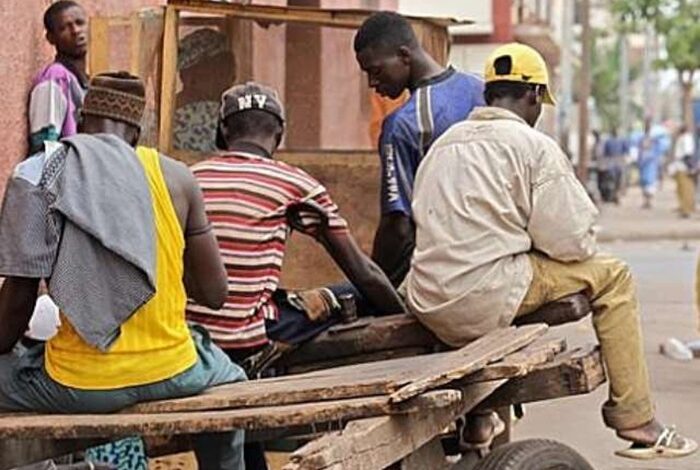
On a typical day in Accra’s busy streets, young people cluster around roadside shops, others ride motorbikes through traffic, while some sit behind small tables selling everything from phone accessories to second-hand clothing.
Many of them hold certificates and degrees. Yet instead of working in offices or industries they trained for, they are hustling daily just to survive.
For thousands of young people in Ghana today, finding stable employment has become one of the biggest challenges of adulthood. Across transport stations, markets, and roadside stalls, the stories are similar graduates searching for opportunities while trying to create their own sources of income.
Many say the struggle is not just about unemployment but also about limited opportunities, growing competition in the job market and a system that often rewards connections over qualifications.
For Silas Adjoke, the challenge of youth unemployment is evident in the difficulty many young people face when trying to enter the job market.
“It is not easy for young people to find jobs now. Sometimes you have to know somebody before you can get a job. That is why many young people are now doing buying and selling or other small jobs just to survive,” he said.
Although Silas is not currently involved in a side hustle himself, he observes that small-scale trading has become common among young people. Many, he says, engage in buying and selling activities or other informal jobs to make ends meet. Like many others, he believes a university degree no longer guarantees employment.
Emmanuel Affum, attributes the problem partly to the increasing number of graduates entering the labour market each year.
According to him, traditional and technical universities continue to produce large numbers of graduates each year many of whom struggle to secure jobs after completing their studies. Those who attempt to explore opportunities outside their field of study often find jobs that cannot sustain their daily needs.
Affum himself is not engaged in any side hustle because his current job demands long working hours, starting from 8 a.m. and sometimes closing as late as 7 or 8 p.m. However, he says many young people around him are turning to self-employment, particularly online selling.
He notes that employment patterns among young people often depend on their level of education. Some males with less formal education work as trotro mates, pragia riders, or okada riders, while those with slightly higher education levels turn to ride-hailing services such as Uber, Bolt or Yango.
Women, he says, are also finding ways to survive through second-hand clothing sales and online shops. However, many of these ventures do not generate enough income for sustainable living.
He further explained that the structure of the labour market itself makes employment difficult for new graduates. Each year, fresh graduates enter the market only to meet others who have been unemployed for years, creating intense competition for limited opportunities. Many young job seekers, he adds, also struggle without professional networks or family connections that could help them secure employment.
“When students graduate, they meet backlog students who couldn’t get jobs from previous years. So they compete against experience, against connections and against the numbers. That is why university education today cannot even guarantee 30 to 40 percent job opportunities,” he said.
Chigozie, a Nigerian youth living in Ghana and currently learning a trade through apprenticeship, believes many young people have been forced to create their own opportunities because formal employment remains difficult to access.
“First of all, this is Africa. In Africa our leaders don’t value the youth. To get work in the government sector you must know somebody. You have to be someone who has “Abraham as a father”. That is why many of us have decided to create something for ourselves just to get something to eat,” he said.
According to him, the frustration among young people is growing because many graduates remain unemployed despite years of education. At transport parks and public spaces, he says, it is common to find graduates without stable jobs.
He believes the challenge is not entirely about the absence of opportunities but how they are distributed, claiming that some individuals hold multiple government positions while others remain unemployed.
Chigozie also points to what he describes as a leadership problem across the continent. Although Africa is rich in resources, he says selfish leadership has contributed to the struggles of many young people. He adds that many leaders educate their children abroad while the youth at home struggle for opportunities.
For him and many others, waiting for government support is no longer realistic. Instead, young people are choosing to survive through small businesses, content creation and other forms of self-employment, valuing even modest daily earnings of GH₵50 or GH₵100.
Chigozie also acknowledged that the desperation created by unemployment sometimes pushes some youths toward crime. “Some people even turn to fraud because nobody helped them and they see it as an opportunity, though it is not the right path,” he added.
Personally, he hopes that learning a trade will help him open his own shop and become his own boss in the future.
Jacob, a young trader, believes government attention is often directed toward formal sectors such as nursing, policing, and other public services, leaving many young people “those on the street,” or in the informal sector, without adequate support.
According to him, trading has become one of the main survival strategies for many youths. Some go to Abossey Okine market to purchase goods, add a small profit and resell them.
However, even trading does not guarantee steady income. On some days, he says, traders return home without making any sales. Many of these young traders also carry family responsibilities, making their situation even more difficult.
Despite the challenges, the determination of Ghana’s youth remains evident.
Across the country, young people continue to pursue apprenticeships, small trading, ride-hailing services, online businesses and other forms of self-employment as they search for stability.
For many of them, the daily hustle is no longer just about ambition, it is about survival in an increasingly competitive job market.



