Ghana’s Food Disinflation Nears Plateau
By Praisebell Rosemond Larbi
Ghana’s food inflation has recorded one of its sharpest corrections in recent history over the past year, marking a decisive turnaround from the acute price pressures that characterised much of 2024 and early 2025. However, while headline figures point to significant relief, underlying price dynamics suggest that the disinflation process is slowing and may be approaching a structural plateau rather than transitioning into outright price stability.
Food inflation declined steeply from 28.3 per cent year-on-year in January 2025 to 3.9 per cent in January 2026, representing a 24.4 percentage-point drop within twelve months. This collapse signals the effective unwinding of Ghana’s food inflation crisis and reflects the combined impact of macroeconomic stabilisation, exchange rate recovery, improved supply conditions, and tight monetary and fiscal policies.
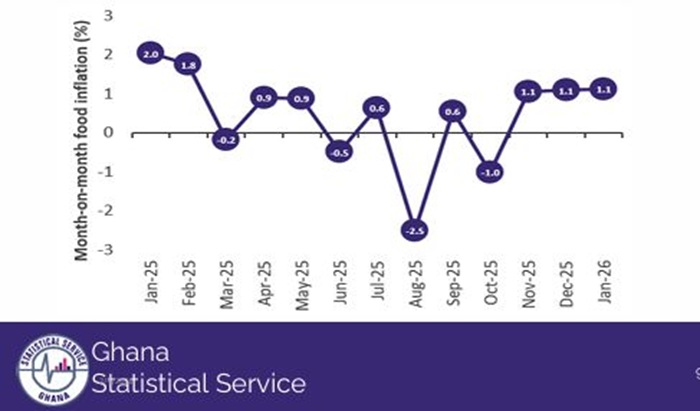
Yet beneath this dramatic annual slowdown lies a more nuanced picture. Monthly food price movements have stabilised around 1 per cent, indicating that while inflation has slowed significantly, food prices are still rising consistently, suggesting persistent underlying pressures within the food value chain.
Rapid Disinflation Driven by Base Effects and Macro Stabilisation
The sharp fall in year-on-year food inflation has been driven by both structural improvements and strong statistical base effects. Exchange rate stability, reduced imported inflation, easing global commodity prices, and improved domestic food supply conditions helped curb price momentum through 2025. These gains were reinforced by tighter macroeconomic policies aimed at restoring price stability.
However, the pace of disinflation was amplified by base effects, particularly from the second quarter of 2025 onward. Between May and November 2025, food inflation declined aggressively from 22.8 per cent to 6.6 per cent, marking the fastest phase of adjustment.
This period coincided with several negative or subdued month-on-month food price readings, including -0.2 per cent in March, -0.5 per cent in June, and a sharp -2.5 per cent in August. These unusually weak monthly outcomes created high comparison bases that mechanically accelerated the fall in annual inflation later in the year.
As a result, a significant portion of the observed disinflation reflects a statistical correction of prior price surges rather than a full reversal of embedded cost structures.
Persistent Monthly Increases Signal Structural Stickiness
Despite the sharp decline in annual inflation, monthly food prices continue to rise at a steady pace. Since October 2025, month-on-month food inflation has remained consistently within the 1.0 to 1.1 per cent range, including in January 2026.
This pattern suggests Ghana has transitioned from a high-volatility inflation environment into one characterised by moderate but persistent price increases. Crucially, this is disinflation—not deflation. Food prices are no longer rising rapidly, but they are not falling, and the cumulative effect of steady monthly increases continues to place pressure on household budgets.
The persistence of these gains points to structural rigidities across the food supply chain, including transport and logistics costs, market inefficiencies, input price stickiness, post-harvest losses, and distribution bottlenecks. These factors limit the extent to which lower headline inflation translates into tangible price relief for consumers.
Evidence of a Disinflation Plateau Emerging
Recent data also indicate a slowdown in the pace of improvement. Year-on-year food inflation declined from 6.6 per cent in November 2025 to 4.9 per cent in December, and further to 3.9 per cent in January 2026. While the downward trend remains intact, the magnitude of monthly declines is narrowing.
As base effects fade and annual comparisons increasingly reflect months of already-lower inflation, the statistical momentum supporting rapid disinflation weakens. Without further supply-side breakthroughs or renewed macro tightening, future reductions in food inflation are likely to be incremental rather than dramatic.
This marks a transition from crisis-driven correction to a phase of structural normalisation, where inflation stabilises at lower levels but remains sticky.