

Africa Policy Lens Warns Ghana Risks Major Revenue Loss with Proposed Lithium Royalty Cut
The Africa Policy Lens (APL) has cautioned that Ghana stands to forfeit substantial revenue should the government proceed with plans to reduce the agreed lithium royalty rate for Barari DV Ghana Limited from 10% to 5%.
The organisation explained that the previous administration, following Cabinet approval to review royalty rates for lithium and related minerals, negotiated a 10% royalty rate with Barari DV Ghana Limited, five percentage points higher than the prevailing rate in the wider mining industry.
However, the current government, whose members had earlier criticised the 10% rate as inadequate, is now proposing a reduction to 5%. The move has sparked public debate and drawn concern from policy groups, including the APL.
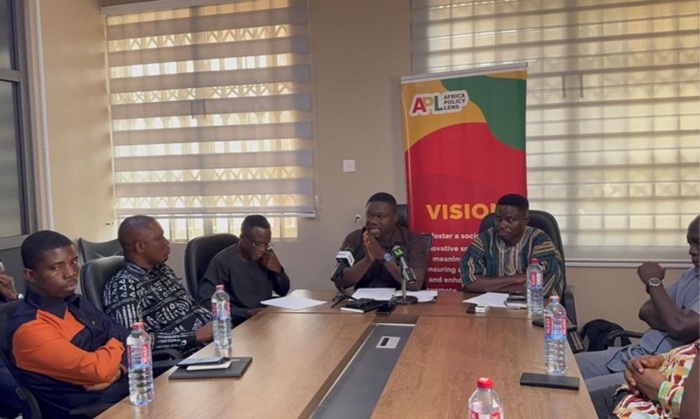
Addressing journalists at a press conference in Accra, the APL expressed surprise that the government would consider a rate lower than what had already been mutually agreed. It warned that such a revision would significantly reduce Ghana’s expected revenue from the Ewoyaa Lithium Project.
“The best international practices in mining investment dictate that royalty rates are not determined by short-term market fluctuations. Even in jurisdictions where sliding-scale royalties apply, upper thresholds are set with future price increases in mind. It argued that recent dips in lithium prices did not justify a downward adjustment of Ghana’s royalty rate,” the group noted.
The APL highlighted that the project’s all-in sustaining cost (AISC) stands at approximately US$610 per tonne, based on a spodumene concentrate price of US$1,587 per tonne. “At this benchmark, the company achieves margins of about 62% per tonne before royalties,” the group said.
The APL added that, even at current market prices of US$1,000–1,195 per tonne, the project remains profitable with margins exceeding 40% per tonne. It cited Zimbabwe’s 2024 decision to introduce an additional 2% levy on gross lithium revenues on top of its existing 5% royalty, as an example of a country increasing, rather than reducing, its mineral revenue share in the face of falling prices.
According to the APL’s financial projections, Ghana could lose between US$210 million and US$630 million over the Ewoyaa Project’s projected 12-year lifespan if the royalty rate is reduced to 5%. These estimates are based on lithium concentrate prices ranging from US$1,000 to US$3,000 per tonne and annual production of 350,000 tonnes.
“Such losses would represent revenue foregone with no avenue for recovery,” the group stressed.
The APL also stated that the existing 10% royalty rate remains economically prudent and firmly in Ghana’s national interest. It further argued that, even at royalty rates as high as 30%, the project would still likely remain commercially viable.



