

North American supply chains at risk following Canadian rail labour dispute
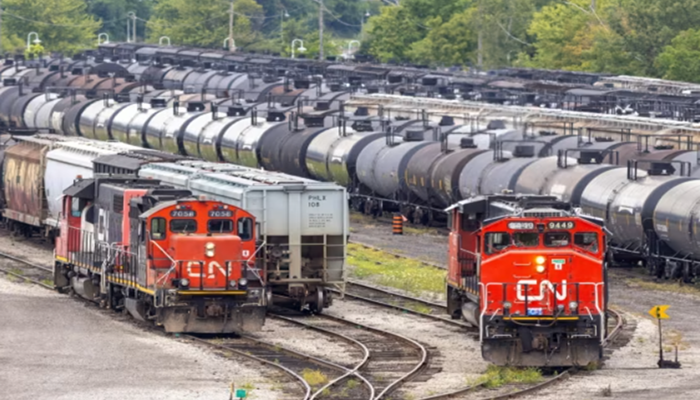
Supply chains across North America are facing significant disruptions following a rail labor dispute in Canada that has led to the shutdown of freight traffic on the country’s two largest railways, Canadian National Railway (CN) and Canadian Pacific Kansas City (CPKC). The rail companies locked out nearly 9,300 workers just after midnight on Thursday (04:00 GMT) after failing to reach an agreement with the Teamsters union.
Canada, which exports around 75% of its goods to the United States—primarily via rail—is now grappling with the potential fallout of a prolonged dispute. The disruption threatens to halt the shipment of a wide range of goods, including grains, potash, coal, and timber, and could also complicate commutes for tens of thousands of people in major cities like Toronto, Montreal, and Vancouver, where commuter lines rely on CPKC-owned tracks.
The vast expanse of Canada, the world’s second-largest country by area, depends heavily on rail transport for both domestic and international trade. However, negotiations between the rail companies and the union, which had already become increasingly contentious, broke down late Wednesday night. Both sides have blamed each other for the impasse, accusing one another of not negotiating in good faith.
In separate statements, CN and CPKC explained that the lockout was a necessary step after months of unsuccessful negotiations. CN emphasized the need for a safe and orderly shutdown, while CPKC framed binding arbitration as the only responsible path forward to protect Canada’s supply chains from further uncertainty.
Paul Boucher, president of the Teamsters Canada Rail Conference, criticized the rail companies, accusing them of prioritizing profits over safety and the well-being of their employees and customers. He argued that the railroads were indifferent to the impact on farmers, small businesses, and supply chains, focusing solely on boosting their bottom line.
Prime Minister Justin Trudeau made a last-minute appeal on Wednesday, urging both sides to continue working towards a resolution, emphasizing the importance of the negotiations for millions of Canadians. His plea came after numerous industry and trade organizations warned that the disruption would have immediate and widespread consequences, damaging Canada’s reputation as a reliable trading partner.
In an open letter last week, these organizations highlighted the potential impact on millions of Canadian jobs, while the US and Canadian chambers of commerce warned of the “devastating” effects on both the Canadian and US economies.
Despite calls from some agricultural trade associations for the Canadian government to intervene with binding arbitration, Ottawa has so far resisted taking that step. Meanwhile, the labor agreements for both CN and CPKC expired at the end of last year, adding further pressure to the situation.
While rail networks in the United States and Mexico continue to operate, the stoppage in Canada is expected to have ripple effects across North America. US Transport Secretary Pete Buttigieg has acknowledged the situation, indicating that the US is monitoring the negotiations and the potential impact on cross-border trade.
With C$380 billion (£214 billion) worth of goods moved by rail each year, and railways responsible for transporting half of Canada’s export goods, the stakes are high. Both CN and CPKC had already begun pausing some shipments in anticipation of the shutdown. Shipping giant Maersk also stopped accepting rail-bound shipments destined for Canada earlier this week, opting instead for road transport where possible. Professor Barry Prentice, director of the University of Manitoba Transport Institute, speculated that if the deadlock persists, the Canadian government may resort to back-to-work legislation, a measure previously used in similar disputes. “This isn’t the best way to run the show,” he remarked, “but it seems to be the playbook, and we’re back on this merry-go-round again.”



