

New Tantalum discovery set to advance clean energy and economic prospects
A new mineral discovery, tantalum, has been identified in large quantities at Bewadze-Mankoadze, located within the Kibi-Winneba Belt in southern Ghana. The mineral was found in pegmatite, an igneous rock, according to a study by researchers Emmanuel Daanoba Sunkari, Joshua Nkansah, and Salaam Jansbaka Adams. Their findings are detailed in the paper, Geochemical Exploration for Tantalum in Coltan-Rich Pegmatites at Bewadze-Mankoadze Area of the Kibi-Winneba Belt, Southern Ghana: Constraints from Exploratory Data Analysis.
The study involved petrographic analysis of rock samples from pegmatite outcrops and statistical assessments of major and minor elements to pinpoint pathfinder elements for tantalum deposits. Ten samples were collected from each town in the area, followed by geochemical testing and the creation of thin sections for microscopic analysis.
Geochemical anomalies, particularly in the southwestern part of the study area, were observed during single and multi-element halo mapping. Based on these findings, the researchers recommend that future exploration activities for tantalum focus on this region.
They further highlighted that pegmatites, rich in tantalum and other valuable minerals like spodumene, beryl, and tourmaline, are abundant in areas such as Ewoyaa, Biriwa, Winneba, Bewadze, and Mankoadze. The study also emphasized tantalum’s critical role in the global shift to clean energy, as the mineral is essential in the production of capacitors used in renewable energy systems, including solar panels, wind turbines, and electric vehicles.
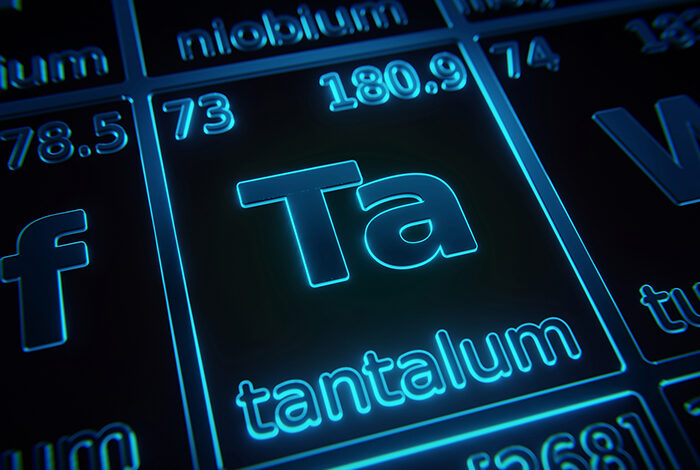
Tantalum, with the symbol Ta and atomic number 73, is a shiny, silvery, corrosion-resistant metal primarily used in electronics, particularly for capacitors. It also finds applications in high-temperature environments, such as aircraft engines, and is widely used in medical and dental devices. The researchers suggested that if the tantalum deposits in southern Ghana were harnessed economically, they could boost the country’s foreign exchange earnings and contribute to local clean energy production.



