

Experts discuss healthcare financing in Africa
By Christabel Oboshie ANNAN, Accra
Country Representative of the World Health Organisation (WHO) in Ghana, Professor Francis Chisaka Kasalo, says that there is the need to scale up coverage of social protection mechanisms in the Africa Region.
He stated that addressing social protection is more than health insurance, and requires taking action on the broader drivers of financial hardship such as improving access to affordable medicines and health products, and improving care for the elderly.
He noted that as the world approaches 2030, greater political will and concerted action is needed to accelerate expansion of healthcare service access and reverse the worsening trend of financial hardship.
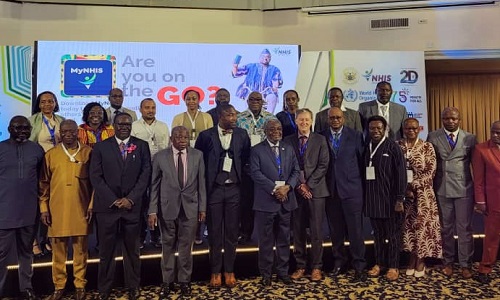
Professor Kasalo said this at Ghana’s maiden Regional Conference on financing Universal Health Coverage (UHC) and Health Security in Accra.
The Conference, held under the theme ‘Overcoming Financial Barriers and Providing Financial Risk Protection,’ was organised by the Ministry of Health (MoH) and National Health Insurance Authority (NHIA) in collaboration with the World Health Organisation (WHO).
The conference seeks to explore new opportunities and ways African countries can work together to advance the agenda of Primary Health Care (PHC) reforms in the African region.
It hosted 30 African countries who will learn from each other on how to tackle inequalities in NHIS system in their countries for access to services without paying unreasonable amounts of money.
Kasalo who read a speech on behalf of the WHO Regional Director for Africa, Dr. Matshidiso Moeti, indicated that the Africa Region needs to work in in a comprehensive and inclusive manner towards achieving Universal Health Coverage.
He explained that governments cannot take on all interventions needed to make progress towards Universal Health Coverage.
“Governments must work with other stakeholders, including those outside the health sector. The private sector can be a useful partner in driving investments and delivering services,” he stressed.
He said that the region must continue to take every opportunity to advocate for increased investment in health and translate governments’ commitment to health into a reality.
He stated that the region must improve efficiency in health spending and work to demonstrate impact with her existing resources.
“We need to improve flow of funds to frontline workers; ensure alignment of all resources to country priorities and address duplications in implementation and monitoring of health programmes,” he advised.
The Minister for Health, Kwaku Agyeman Manu, also said that reforms are needed to improve the health security of the African Region.
He stated that improving the health security of the region would significantly improve emergency preparedness and response.
He noted that health finance is an important part of health systems that facilitates progress towards UHC by improving effective service delivery and financial security even during emergencies.
“Financing has an extremely important impact on the performance of a health system.
“It determines how much money is available, who bears the financial burden, who controls the funds, how risks are pooled and whether health care costs can be controlled,” he explained.
The Director General of WHO, Dr. Tedros Adhanom Ghebreyesus, urged African countries to protect health budgets and if possible increase how much they prioritise the poorest and the most vulnerable.
He further advised African countries to strengthen coordination within sectors including the private sector to drive, align policies, resources use and implementations.
He added that the African Region should facilitate the requirements for Primary Healthcare approach on the path to the most efficient, effective and equitable points to Universal Health Coverage and security.



