

US envoy unveils Africa climate tech innovators programme
By Selorm GBORBIDZI, Accra
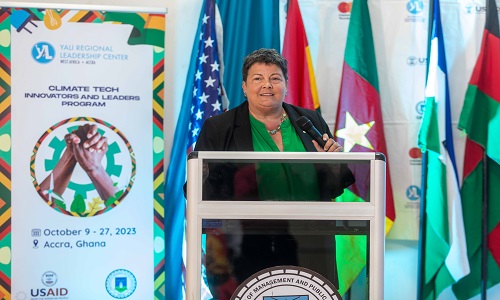
THE United States Ambassador to Ghana, Virginia Palmer, has launched the Africa Climate Tech Innovators Programme.
The Programme, which is under the auspices of the Young African Leaders Initiative (YALI), and is being funded by the United States Agency for International Development (USAID), will see 50 climate tech innovators from East, West and Southern Africa, hosted by the YALI Regional Leadership Centre, West Africa, over a 3-week period.
They will come up with innovative, environmentally friendly solutions to problems facing the continent, but will also make a positive impact in the global efforts towards mitigating the effects of global warming and climate change.
The YALI Climate Tech Innovators and Leadership Programme provides a platform for young African leaders to develop new skills and acquire new knowledge, and build connections with like minded people to find new ways of dealing with local and global problems.
In her address to the 45th cohort of the YALI, Ambassador Palmer stressed that the issue of climate change is not a theoretical one, but a real problem that is bringing hardships to many places around the world, particularly in Africa.
She said, “climate change is no longer a theoretical problem. It is here now. Here in Ghana, we see changing patterns and crop yields. Climate change is climate reality.”
She pointed out that 17 out of 20 most climate-vulnerable countries are on the continent, which makes it important for Africans to be part of the global efforts to find solutions.
Ambassador Palmer stated, “we need sustainable solutions to the climate crisis that rely on Innovation and create new industries, new jobs and new opportunities.”
She reminded the techy participants that it is not too late as there are tools and knowledge they can apply to hold back the climate change tide and build a sustainable future.
She noted, “this programme will equip you with the skills and knowledge to address climate challenges head-on. But it’s about how you will apply that knowledge. Your solutions need to be sustainable – and hopefully profitable – to make a long-term impact.
The Rector of the Ghana Institute of Management and Public Administration (GIMPA), Professor Samuel K Bonsu, cautioned against the potential mass extinction if climate change is not tackled, with over one million animal species in danger of extinction.
He advised the members of the cohort to take advantage of unique opportunity to given them, saying, “do not take your participation in this programme for granted.”
He described this year’s cohort as a novelty, revealing that this was the first time YALI was bringing together an inter-regional group under its umbrella.
He said, “the diversity of ideas we are going to share, allow for potentially beneficial cross-fertilisation of ideas that will lead to action.”
The Executive Director of the Environmental Protection Agency (EPA), Henry Kwabena Kokofu, in a statement read on his behalf, indicated that Ghana, under the Green Climate Fund, has received readiness support funding to develop an early warning drought and forecasting system through the United Nations Framework Convention on Climate Change (UNFCCC).
He expressed the readiness of the EPA to to support any innovative abd sustainable technology that the youth may incubate and develop.
He therefore urged young people to take advantage of some of these programmes to become channels for expanding these technologies across the nation.



