

Bawumia unveils vision
-E-levy to be scrapped, new flat tax regime, reducingcost of living, not more than 50 ministers, Housing for All among others
By Elvis DARKO, Accra
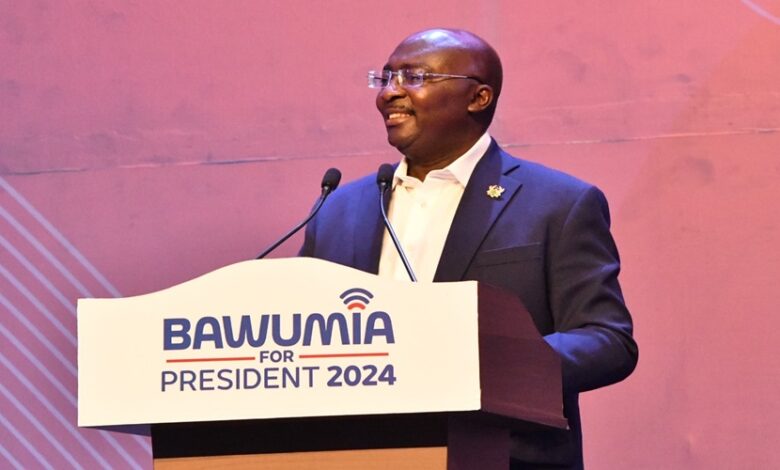
Vice-President and Flagbearer of the New Patriotic Party (NPP), Dr. Mahamudu Bawumia, has unveiled his vision as he seeks the mandate of Ghanaians to be the next president of Ghana.
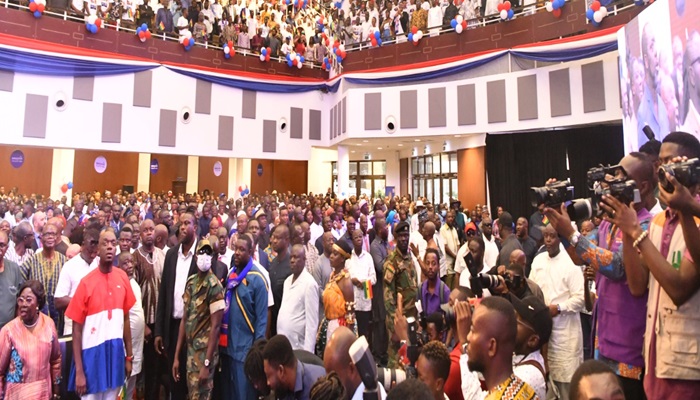
The policies include introducing a flat tax regime, scrapping Electronic Transactions Levy (E-Levy), reducing the cost of living, appointing not more than 50 ministers, ensuring macroeconomic stability, stricter amendments to the Fiscal Responsibility Act, and building a digital Ghana.
Others include leveraging technology, data, and systems to train one million digital talents for inclusive economic growth, implementing youth policies centered on technology and vocational training for jobs, and introduce housing for all policy.
He also promised to prioritize the use of electric vehicles to reduce transport costs by 30-40%, pursue a golden age for the private sector to deliver infrastructure and services to reduce expenditure, prioritize empowering small-scale miners to grow their operations and undertake responsible mining, as well as rethink natural resource management contracts.

E-levy to be abolished
Speaking to the nation in Accra yesterday to unveil his vision, he promised to abolish the controversial Electronic Communication Levy (E-Levy). Dubbed the Next Chapter speech, the flagbearer of the NPP said that under his leadership, the E-levy would be a relic of the past.
Tax returns filing
To enhance better tax administration and collection, he stated that incentives must be provided to encourage people to file their tax returns even if they will pay zero taxes.
Dr. Bawumia conceded that the current tax regime, implemented since independence, has failed the country.
“We want a regime that is easy to understand, easy to comply with, and easy to enforce, and that is not subject to so much discretion.
“Many individuals and businesses find our tax system cumbersome and confusing, and many feel harassed by the GRA,” he stressed.
Flat tax regime
In view of that, Dr. Bawumia promised a new, “friendly” flat tax regime explaining that “My administration will introduce a very simple, citizen, and business-friendly flat tax regime.
He pledged a flat tax regime of a percentage of income for individuals and SMEs, which constitute 98% of all businesses in Ghana, with appropriate exemption thresholds set to protect the poor.
Dr. Bawumia also noted that, with digital reforms to boost online filing of tax, executing tax returns should be completed in minutes.
“With the new tax regime, the tax return should be completed in minutes! We will also simplify our complicated corporate tax system and VAT regime.”
Amnesty for tax defaulters
He also stated that, to start the new tax system on a clean slate, his government will provide a tax amnesty, i.e., a complete exemption from the payment of taxes for a specified period and the waiving of interest and penalties, up to a certain year, to individuals and businesses for failures to file taxes in previous years so that everyone will start afresh.
E-invoicing
The NPP Flagbearer also stressed that with the new system; there will be no need for GRA to send officers to go sit in shops and monitor proceedings to collect taxes, adding that E-invoicing, as being implemented by the GRA, will be extended to all companies.
Dr. Bawumia also said his government would amend the law such that if there is a dispute about tax assessment, binding arbitration will take place through a body constituted by institutions such as the Ghana Arbitration Center, Institute of Taxation, AGI, Institute of Chartered Accountants, PEF, and Ghana Employers Association, with a mandate to resolve any appeal in a maximum of three months.
Digital Ghana
He declared that his objective is to build what he has labeled Digital Ghana, which will be ready for the ongoing global digital revolution for inclusive economic growth in Ghana.
According to him, his goal is to eliminate the digital divide by achieving close to 100% internet penetration.
“We have already made very significant progress in this direction by increasing internet penetration from 34% in 2016 to 72% in 2023 by more than double.
The task in the next four years is to move from 72% to close to 100%! It is possible!”
Ministers and Deputies will not exceed 50
The Vice-President pledged that under his Presidency, there will not be more than 50 Ministers and Deputy Ministers.
According to Dr. Bawumia, an efficient system of governance will require fewer ministers, hence, his decision to have fewer ministers.
He also touched on the need to enhance the role of the private sector along with fiscal and administrative decentralization while improving how systems and institutions function.
This, he said, would lead to greater efficiency and ensure value for money in procurement.
“The move towards the private sector provision of many public services would create fiscal space of at least 3% of Gross Domestic Product (GDP).
This represents a major paradigm shift. Additionally, an efficient system of governance will require even fewer ministers,” he added.
Independent fiscal responsibility council
He announced the setting up of an independent fiscal responsibility council to reduce budget deficits and interest rates.
Dr. Bawumia promised that the Fiscal Responsibility Act will also be amended to add a fiscal rule that requires that budgeted expenditure in any year does not exceed 105% of the previous year’s tax revenue to prevent the experience of budgetary expenditures based on optimistic revenue forecasts which don’t materialize.
Rethink of natural resource management contracts
Dr. Bawumia called for a new paradigm in natural resource contracts to ensure the nation maximizes benefits of its natural resources.
Successive governments have often come under criticism for the type of agreements entered into with external interests for the exploitation Ghana’s natural resources.
He outlined a number of measures, including value addition and Ghanaian ownership, describing them as key.
“As President, I will usher Ghana in a Golden age for the maximization of the benefits from our natural resources like gold, lithium, bauxite, and so on.
“The key to doing this is value addition and Ghanaian ownership. We need a new paradigm in natural resource contracts,” he said
Empowering small-scale miners
Dr. Bawumia said some of the key policies his government will implement to maximize Ghana’s benefits from its natural resources will include measures to “formalize, regularize and regulate environmentally sustainable small-scale mining.”
About one million people are engaged in small-scale mining and the NPP flagbearer has pledged to help grow small-scale mining companies into large-scale companies with capacity building and assisting them to access financing to acquire equipment. We can create many millionaires in the small-scale mining industry if we support them
Dr. Bawumia added that in line with this, his government “will license all miners doing responsible mining. District Mining Committees, including chiefs, will provide initial temporary licenses to miners.”
“As long as miners mine within the limits of their licenses, for example no mining in rivers or water bodies, there will no longer be any seizure or burning of excavators,” he said.
Dr. Bawumia added that, under his government, every Ghanaian in Small Scale Mining will register under Ghana Small Scale Miners Association with their Ghana card.
Mining sector initiatives
Other initiatives Dr. Bawumia announced for the mining sector are a pension scheme for small-scale miners as has been done for cocoa farmers, introduction of vocational and skills training on sustainable mining for small-scale miners in the curriculum of TVET institutions, provision of equipment to government authorities in mining communities to undertake reclamation of land, setting up state-of-the-art common user gold processing units in mining districts in collaboration with the private sector.
Others are conducting an audit of all concessions with various licenses and new applications, which will allow the government to know licenses that have expired and non-compliance with licensing conditions and abolishing VAT on exploration services (like assaying) to encourage more exploration.
Minerals Development Bank
It also comprises establishing a Minerals Development Bank to support the mining industry, establishing (through the private sector) a London Bullion Market Association (LBMA) certified gold refinery in Ghana within four years, and all responsibly mined small-scale gold produced will be sold to the central bank, PMMC, or MIIF and will be required to be refined before export.
Reducing the cost of living
Dr. Bawumia laid out a four-point vision on agriculture, housing, transportation, and power to help reduce the rising cost of living under his Presidency.
He admitted the rising cost of living globally, including in Ghana, and identified the four key sectors affecting the cost of living.
“The cost of living in the world has increased massively following the COVID pandemic and the Russia-Ukraine war.
“Global inflation increased from 1.55% in 2016 to 8.27% at the end of 2022, a fivefold increase! In particular, the increase in the cost of living has been driven by increases in food prices, energy prices, housing (rents), and transport prices.
“Any attempt to reduce the cost of living on a sustainable basis must, therefore, tackle agriculture, energy, housing, and transport prices, and that is what I am going to do.
Agriculture
On agriculture, Dr. Bawumia outlined a comprehensive plan for modern agriculture to ensure precision agriculture and food security.
He aims to achieve food security through the application of technology and irrigation to commercial large-scale farming.
“We will also promote the use of agricultural lime to reduce the acidity of our soils, enhance soil fertility, and increase yields from fertilizer application. Ghana has an abundance of limestone to facilitate this.
“I will prioritize the construction of the Pwalugu Dam by utilizing private sector financing to attract grant financing,” he assured.
Public Transportation
Regarding public transportation, Dr. Bawumia announced that his government intends to promote the use of electric vehicles, which he believes will positively impact factors affecting the high cost of public transport in Ghana.
“My administration will strive to reduce the cost of public transport by 30-40% through the adoption of electric vehicles for public transportation,” he noted.
“The public transport pricing formula is primarily influenced by two key variables: the price of fuel and the price of spare parts. Electric vehicles do not require petrol or diesel, and spare parts are minimal.
“This is what will lower the fares for electric vehicles. More importantly, transport fares for electric vehicles will be stable, and the frequent and significant fare increases will become a thing of the past,” he added.
Housing for All Policy
Under Housing for All policy, Dr. Bawumia’s government intends to focus on providing public housing, similar to Singapore’s approach.
The initiative involves partnering with the private sector to construct large housing estates without the government needing to borrow or spend.
Additionally, the National Rental Assistance scheme, which has been successful, will be enhanced to address issues such as demands for rent advances of two years or more.
Power sector reform
Dr. Bawumia noted that as part of efforts to reduce the cost of living, policies will be implemented to achieve energy self-sufficiency at reduced costs through solar and other renewables, with a focus on market efficiency in the energy sector.
Introduction of 2,000MW of Solar Power
To diversify the energy generation mix, he stated that 2,000 megawatts of solar power and additional wind power through independent power producers will be introduced to reduce Ghana’s reliance on oil and gas by the end of his first term in office.
This, he believes, will significantly reduce electricity costs.
“With reliable and cost-competitive power, we will attract more manufacturing capacity to the country, create more jobs, improve services, export more products, and support our AfCFTA strategy to enhance the participation of Ghanaian industries in intra-Africa exports and trade,” he said.



