

Ghana’s T-bill crisis deepens as fourth consecutive week sees 35% funding shortfall
By Emmanuel Boateng
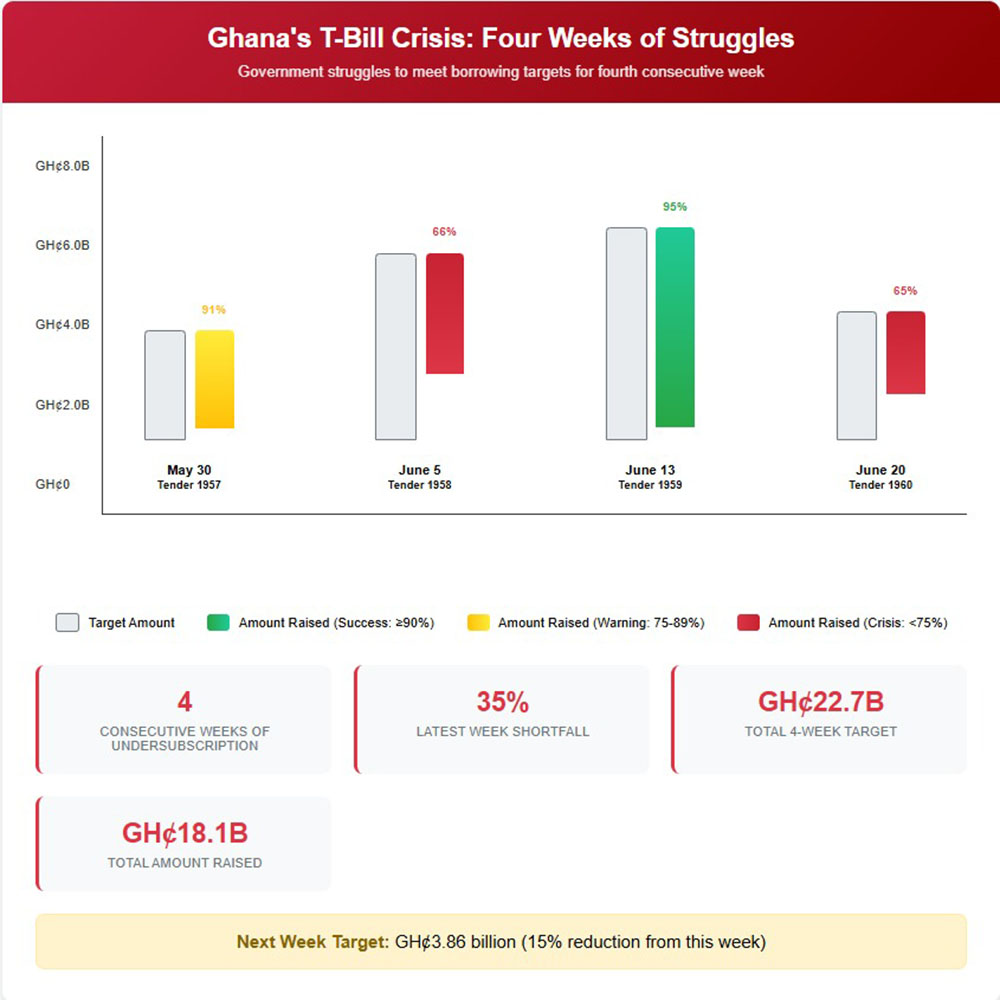
Ghana’s domestic debt challenges intensified dramatically this week as the government managed to raise only GHS2.95 billion against a target of GHS4.55 billion in its Treasury bill auction, marking the fourth consecutive week of undersubscription and the worst performance in the current cycle.
The June 20 auction (Tender 1960) saw investor bids totaling just GHS3.37 billion, a massive 26 percent shortfall from the government’s already reduced target. More concerning, the government accepted only GHS2.95 billion of these bids, representing just 65 percent of their borrowing goal and signaling increasingly selective bid acceptance as yield expectations diverge.
This week’s performance represents a significant deterioration from the previous auction on June 13, where the government achieved 95 percent of its GHS7.59 billion target, raising GHS7.19 billion. It is our position at ZED Multimedia that the sharp decline in both investor interest and government acceptance rates points to a deepening crisis in domestic debt market confidence.
The breakdown reveals systemic weakness across all tenors. The benchmark 91-day bill attracted bids of GHS2.42 billion with only GHS2.19 billion accepted, while the 364-day instrument saw particularly weak demand with just GHS236 million in bids against typical requirements exceeding GHS500 million.
Market analysts suggest that the government’s strategy of pushing yields lower is backfiring spectacularly. The weighted average rate on the 91-day bill fell to 14.70 percent, continuing a month-long decline from peaks above 15 percent. However, this apparent “cheap money” approach has coincided with the worst investor response in recent memory.
“The mathematics are stark,” noted financial market observers. “Lower yields were supposed to reduce borrowing costs, but if you can’t raise the money at all, the exercise becomes counterproductive. The government is discovering that there’s a floor below which investors simply won’t participate.”
The selective bid acceptance pattern reveals the government’s dilemma. On the 364-day bills, authorities rejected approximately 33 percent of submitted bids, likely due to investors demanding yields above the government’s comfort level. This strategy helps avoid locking in higher long-term rates but severely limits fundraising capacity.
Economic analysts argue that multiple factors are converging to create this perfect storm. Pre-election fiscal pressures typically increase government borrowing needs precisely when investors become more cautious about political risks. Additionally, the ongoing IMF program implementation creates uncertainty about future policy directions, taxation changes, and debt sustainability measures.
The declining auction targets themselves tell a concerning story. After failing to meet larger targets in previous weeks, the government reduced this week’s target to GHS4.55 billion, yet still achieved only 65 percent success. Next week’s target has been further reduced to GHS3.86 billion, suggesting authorities are lowering expectations rather than addressing underlying market concerns.
Broad economic theory suggests that when both yield reductions and target reductions fail to restore market confidence, deeper structural issues are at play. The domestic investor base, primarily banks, pension funds, and asset managers, appears to be either liquidity-constrained or seeking alternative investment opportunities.
This trend has serious implications for fiscal management. Ghana’s heavy reliance on domestic borrowing to fund budget operations means that sustained undersubscription forces difficult choices: accept higher borrowing costs, reduce government spending, or seek alternative financing sources including potentially inflationary central bank financing.
The regional context adds another layer of concern. While Ghana’s Producer Price Index shows encouraging disinflationary trends that should theoretically support lower yields, the T-bill market’s rejection of these lower rates suggests investors remain skeptical about the broader macroeconomic outlook.
Looking ahead, market watchers will closely monitor whether next week’s reduced GHS3.86 billion target can restore some market confidence or if the downward spiral continues. It is our position at ZED Multimedia that without addressing underlying investor concerns about fiscal sustainability and policy uncertainty, simply reducing targets and yields will prove insufficient to restore market functionality.
The implications extend beyond immediate financing needs. A sustained crisis in the domestic debt market could force the government to rely more heavily on external financing, potentially compromising fiscal sovereignty, or to implement more aggressive spending cuts that could impact economic growth and social services.
For investors, the current environment presents both risks and opportunities. Those demanding higher yields may eventually force a repricing of government debt, while the government’s financing constraints could create space for private sector borrowers to access capital at more competitive rates.
The coming weeks will test whether Ghana’s domestic debt market dysfunction represents a temporary adjustment period or signals more fundamental challenges requiring urgent policy intervention.
Tender 1960 Results (June 20, 2025):
• Target: GHS4.55100 billion
• Bids Received: GHS3.37062 billion (74 percent of target)
• Amount Accepted: GHS2.95291 billion (65 percent of target)
• 91-day yield: 14.70 percent (continued decline)
• 182-day yield: 15.25 percent
• 364-day yield: 15.69 percent
Next Week Target: GHS3.86000 billion (15 percent reduction)



