Ghana–EU Sign Security and Defence Partnership to Tackle Regional Threats
By Maame Efua Kwaduah
Ghana has received significant military equipment and security support from the European Union under the European Peace Facility (EPF).
It is imed at strengthening the country’s security capacity and addressing the spillover of insecurity from the Sahel.
Ghana is among the beneficiaries of the European Peace Facility, with total support valued at €50 million. Two assistance measures adopted in July 2023 and April 2024 are aimed at bolstering the capabilities of the Ghana Armed Forces in areas such as intelligence, surveillance, mobility, electronic warfare, military engineering, riverine operations and explosive ordnance disposal.
The latest handover of EPF military equipment follows the earlier provision of 105 militarised vehicles in 2023, as well as major deliveries between 2024 and 2025, including electronic warfare systems such as jammers and IMSI catchers, intelligence and surveillance equipment including unmanned aerial vehicles, riverine equipment, military engineering tools, drones and other systems.
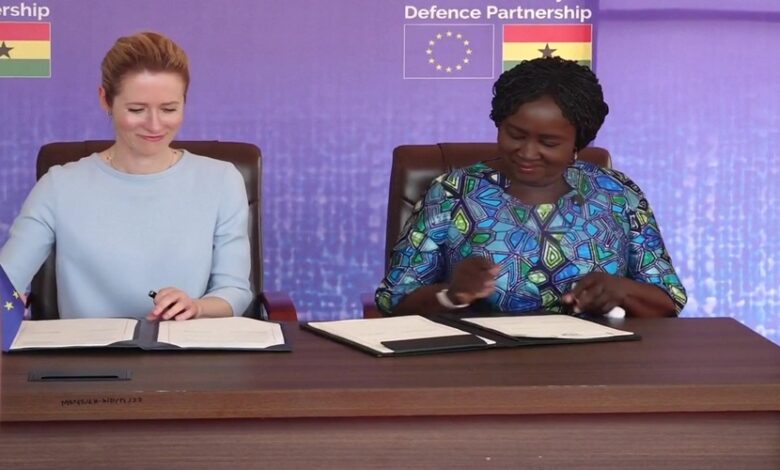
Speaking at the ceremony, Vice President Professor Naana Jane Opoku-Agyemang said the occasion highlights the long-standing partnership between Ghana and the European Union and their shared commitment to peace, stability and sustainable development.
She noted that Ghana and the European Union have formally established a Security and Defence Partnership, with Ghana becoming the fifth African country to join the initiative, alongside partners such as the United Kingdom, Canada, Japan and Norway.
According to her, the partnership reflects the growing collaboration between Ghana and the European Union in tackling evolving security challenges, particularly in West Africa and the Sahel region.
She said complex security threats continue to emerge across West Africa and cited a recent tragic incident involving Ghanaian traders who lost their lives in Burkina Faso as a reminder of the dangers posed by insecurity in the sub-region.
In the face of these challenges, she said partnerships such as the Ghana-EU Security and Defence Partnership are essential in promoting regional cooperation to protect lives and maintain peace and stability.
The Vice President expressed gratitude to the European Union for its continued support under the European Peace Facility and the EU Security and Defence Initiative, revealing that more than 30 security-related projects are currently being implemented in Ghana in areas including counter-terrorism, border management, maritime security and cyber security.
She added that the EU Security and Defence Initiative in the Gulf of Guinea has also organised about 40 training sessions for Ghana’s military and civilian security personnel and provided equipment to support their work.
According to her, the transfer of security equipment, systems, motorcycles and drones will significantly strengthen Ghana’s efforts to build the capacity and operational readiness of its security forces and enhance the country’s ability to respond to emerging threats.
She also acknowledged the militarised vehicles provided to the Ghana Armed Forces in 2023, noting that they have improved operational mobility and readiness, while communication and intelligence equipment delivered in 2025 has enhanced situational awareness and operational coordination.
Professor Opoku-Agyemang said the Security and Defence Partnership provides a structured framework for strengthening cooperation between Ghana and the European Union in capacity building, crisis response and peace operations.
She reaffirmed Ghana’s commitment to working with the European Union to promote peace, strengthen democratic governance and address the root causes of insecurity, including poverty, marginalisation and youth unemployment.
Under the first EPF assistance measure adopted on July 10, 2023, support valued at €20.25 million was provided to Ghana, including €8.25 million from the EPF and €11.25 million representing the estimated value of vehicles seized under Operation Irini and transferred to Ghana.
The support focused on intelligence and surveillance systems, electronic warfare equipment, mobility support including the 105 militarised vehicles, military engineering equipment, riverine equipment and explosive ordnance disposal capabilities. The implementation of this assistance measure ended in January 2026.
A second assistance measure worth €25 million was adopted on April 4, 2024, to complement the earlier support by strengthening Ghana’s capacity in medical support, military engineering, logistics training, military intelligence, electronic warfare, communication and explosive ordnance disposal. The measure is currently under implementation and deliveries are expected to continue throughout 2026.
The Ghana-EU Security and Defence Partnership also focuses on key areas such as maritime security in the Gulf of Guinea, peacebuilding and crisis management, counter-terrorism, cyber security, conflict prevention, climate and security, capacity building and multilateral cooperation, including support for African-led solutions to African security challenges.