Lifeline for women-led businesses
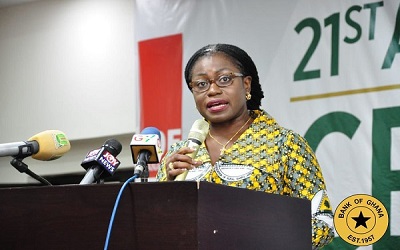
. BoG pledges unwavering commitment
By Isaac AIDOO, Accra
The Bank of Ghana (BoG) has pledged unwavering commitment to providing a lifeline to women-led businesses to better the lot of Ghanaian women, “as part of efforts to help our economy recover from the current macroeconomic challenges, and make it more resilient going forward.”
According to the regulator, in addition to providing the enabling regulatory environment to promote financial stability, “ we are fully committed to promoting inclusive finance and gender inclusive finance particularly.”
These were contained in a speech read on behalf of the Governor of the Bank , Dr Ernest Addison by the Second Deputy Governor, Mrs. Elsie Addo Awadzi during the launch of Affirmative Finance Action for Women in Africa (AFAWA) finance series.
Initiatives to increase women’s access to finance ongoing
The BoG Boss maintained that government’s National Financial Inclusion and Development Strategy (2017-2022) set out to increase access to finance for women as part of a comprehensive strategy to increase financial inclusion to underpin inclusive macroeconomic growth and development.
Other government interventions such as credit lines to SMEs through the Ghana Enterprises Agency, the Ghana Women Fund, and others continue to provide a lifeline to women empowered businesses.
$44.025billion AfDB support for women-led businesses
The Governor welcomed and praised the efforts of the African Development Bank (AfDB) which is at the forefront of promoting more access to finance for women-owned businesses through a number of interventions including the AFAWA initiative.
The initiative seeks to close US$42 billion access to finance gap for women-empowered
businesses in Africa over the next five to six years by working with partner financial
institutions and through innovative financing instruments to provide capacity building
and policy dialogue to support appropriate legal and regulatory reforms.
BoG committed to Action Plan on Gender Inclusive Finance
As a member of the Alliance for Financial Inclusion, the Bank of Ghana has made commitments under the Denarau Action Plan on Gender Inclusive Finance, to advance gender inclusive finance with emphasis on promoting women’s access, usage and quality of financial services and products
“We continue to strengthen critical credit market infrastructure such us our credit
bureau-based credit reporting system and our Collateral Registry to help facilitate
lending to MSMEs and women-owned businesses,” the Governor stated.
Promoting financial inclusion, gender equity
Dr Addison recalled that in November 2019, the Bank of Ghana launched Ghana’s Sustainable Banking Principles – a set of seven ESG–related principles, which enjoins banks to among other things promote financial inclusion and gender equity in their internal operations andin relation to their delivery of products and services to clients. Banks are currently reporting to the Bank of Ghana on a quarterly basis, in compliance with these principles, and we expect to see higher levels of compliance.
“We believe that the AFAWA initiative will be critical in supporting the banks with the necessary capacity building and sources of funding to support their efforts at improving more gender inclusive finance,” the BoG Governor stated.
The partnership between AFAWA, the AGF, and the Ghana Association of Banks was
therefore very timely and urgent, as part of efforts to help our economy recover from
the current macroeconomic challenges, and make it more resilient going forward.
AFAWA partnership to spur women’s businesses to exploit AfCFTA
The partnership also holds great potential to equip women-owned businesses to
spearhead the development of the single Africa market under the African Continental
Free Trade Agreement to help expand the Ghanaian economy and create more jobs for its youthful population.
Role of financial sector
He emphasized that the financial sector had an important role
in advancing access to finance for women-owned businesses. We expect that financial
services take up this challenge and see the business opportunities that remain
untapped in the women market, in order to build a stronger and more resilient financial
sector.
Data collection policy making, regulation
The BoG had recently implemented a new online reporting and analytics
supervisory tool by which our regulated financial institutions submit their prudential
returns to us on a monthly basis on a sex-disaggregated basis. As a result, financial
institutions report not only aggregate numbers in terms of financial products and
services, but also the gender dynamics of their customer base and product and service
offerings.
“This should help address current data constraints and provide critical data
for evidence-based design of policy making, regulation, and supervisory measures as
well as financial products and services,” the Governor indicated.
AfDB increases women’s access to finance in Ghana
The African Development Bank (AfDB) is working towards ensuring that women entrepreneurs in Ghana get more access to finance to grow and sustain their businesses.
The move by the AfDB is to empower the financial institutions to explore practical solutions to increase women’s access to finance, such as innovative and tailored financial products and non-financial services, digital technologies, and policy reforms.
The Bank is doing this together with the African Guarantee Fund and the Ghana Association of Banks (GAB) to reduce the gender gap in access to finance, and enable women-led businesses to increase their contribution to economic resilience and national development.
The International Finance Corporation (IFC) reports that the formal finance gap for Micro-Small and Medium-sized Enterprises (MSMEs) in Ghana is estimated to approximately USD 5 billion.
AFAWA, therefore, seeks to address the various bottlenecks that impede women in Ghana to have access to credit and other financial support services to grow their businesses sustainably.
Country Manager, Ghana Office, AfDB, Eyerusalem Fasika, said the bank would identify opportunities for collaboration between governments, financial institutions, and other stakeholders to support women entrepreneurs.
She said the flagship initiative (AFAWA), was specifically focused on increasing inclusive finance for women entrepreneurs on the continent, adding that AfDB had invested $1 bn to be on-lent to women SMEs in 27 countries across Africa since 2021.
Mad Fasika called on all stakeholders to “work together to ensure that women have the resources and support they need to unleash their full potential and contribute to the development of our continent”.
She noted that the Bank as part of its 2021-2025 Gender Strategy to put women’s economic empowerment at the centre of its High Five Development strategy, came up with AFAWA as its first pillar.
The Country Director lauded Ghana’s effort in supporting and promoting women-led businesses and financial inclusion, which had led to it being “one of the top three countries in the world with the highest proportion of women entrepreneurs”.